
Technology expense management puts telecom, wireless, software, IT asset and utility bills through one audit and one report, so every site stays visible. For finance, IT and procurement teams at multi-site companies, it catches the charges that keep billing after a site closes or a user leaves.
What You REALLY Need to Know about Technology Expense Management
Run every technology and utility bill against one site list, and each location’s cost, renewals and closures show up in the same place.
- Give every account, meter, line and license a location ID, cost center and general ledger (GL) code.
- Route each site closure and employee exit to every category that bills for it.
- Add new categories to your telecom program one at a time.
Which Technology Costs Should One Expense Program Cover?
One expense program should cover wireline and data circuits, wireless lines and devices, software licenses, IT assets and leases, and utilities at every site. Each category bills by account, line, seat, serial number or meter, so each needs its own check before your accounts payable (AP) team pays it and the cost posts to the GL.
| Category | What shows up on the bill | What gets checked before payment | What finance gets |
|---|---|---|---|
| Wireline and data circuits | Circuit, line and usage charges by account | Line-item audit against contracted rates and inventory | GL-coded charges and accrual files by site |
| Wireless lines and devices | Line, plan and device charges | Employee ID check against the HR roster; zero-use lines | Charges by user, department and cost center |
| Software licenses and cloud subscriptions | Seat and subscription charges | License seats and renewal dates | Split billing across cost centers |
| IT assets and leases | Equipment and lease charges | Serial numbers and lease terms | Asset serial numbers by site |
| Utilities (electric, gas, water, sewer, waste) | Meter, usage and rate charges | Meter-level audit against tariff, contract and consumption | kWh and therms by site, cost by meter |
Utilities belong in the same program as telecom expense management (TEM) because they follow the same sites. A new store needs a circuit, wireless lines and an electric account, and those bills land on the same AP desk. When the store closes, all of them have to stop.
When Does a Multi-Site Company Need More Than Telecom Expense Management?
You need more than TEM once your sites bill in several categories and no single report shows what each location costs. TEM covers circuits and wireless lines, so the software, IT asset and utility bills for those same sites sit outside its audit.
- Your AP team keys invoices from separate telecom, wireless, software and utility vendors for the same sites.
- Software renewal dates and carrier contract end dates live in email threads.
- A closed site keeps billing in more than one category, such as a circuit and an electric meter.
- Each category sits in its own tool or with its own provider.
If these conditions match your company, request a complimentary TEM consultation or ExpenseLogic demonstration to see how RadiusPoint would add your other categories to your telecom program.
See Every Location’s Technology and Utility Costs in One Report
A site-level report puts each location’s telecom, wireless, software, IT asset and utility charges in one view, so finance can compare sites directly. Your finance lead can then weigh each site’s technology and utility cost against what that site earns.
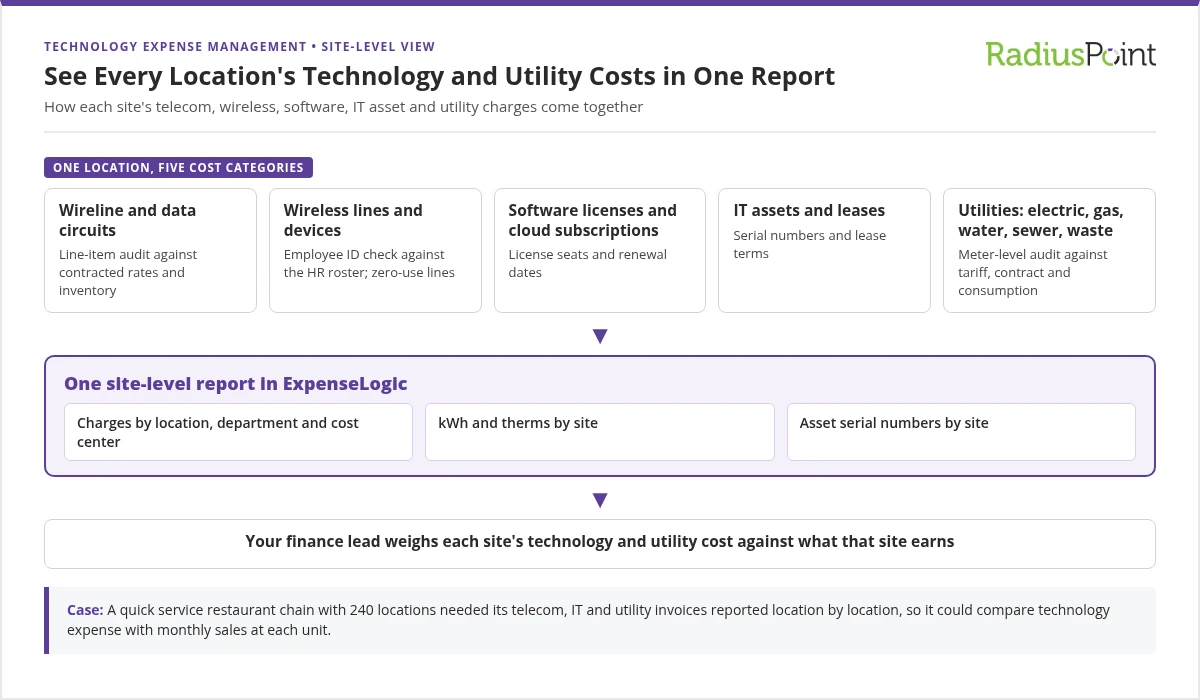
A quick service restaurant chain with 240 locations across five major metro areas and smaller US cities needed its telecom, IT and utility invoices reported location by location, so it could compare technology expense with monthly sales at each unit. RadiusPoint consolidated those invoices in ExpenseLogic, and its team took over invoice input, error detection and reporting from the client’s AP team. ExpenseLogic’s location-level reports gave the chain’s management team the cost-to-sales data it needed for each unit. At multiple locations, the chain found unneeded DSL lines used for Wi-Fi that could be canceled and outdated HVAC equipment to replace to lower monthly energy costs. It also found costly POS phone lines to replace with lower-cost VoIP lines.
The report breaks charges out by location, department and cost center, with kWh and therms by site from Utility Expense Management (UEM) and asset serial numbers by site.
Stop Paying for Closed Sites, Former Employees and Unused Licenses
A site closure has to stop that location’s circuits and meters, and an employee exit has to stop that person’s wireless lines and license seats. Real estate system feeds and a monthly HR roster carry both events into the expense program.
When a location closes, real estate system integration starts the disconnects, and closed-location billing exception reports catch any bill that still arrives. ExpenseLogic checks the Employee ID on each wireless line against the roster to find lines still assigned to former employees, and the same inventory flags zero-use mobile lines. Your IT manager reviews unused license seats before each renewal.
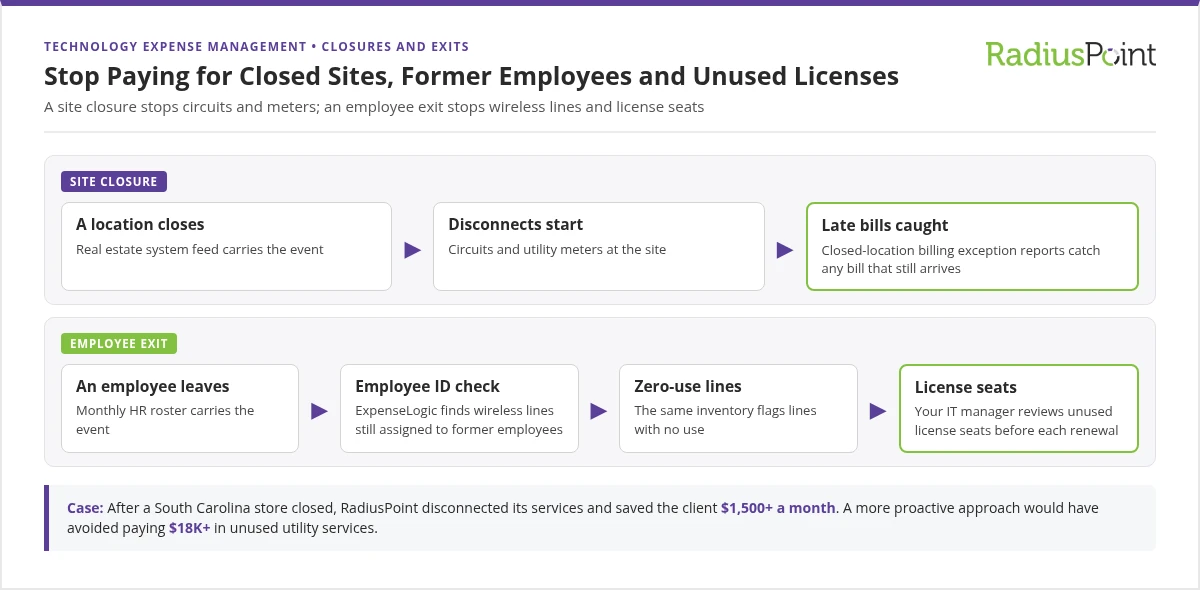
A national eyeglass and contacts manufacturer-retailer with 3 labs and 170 retail locations had utility bills for electricity, gas and water that kept arriving and getting paid after a South Carolina store closed. RadiusPoint identified the closed store, contacted vendors to disconnect services, flagged the closed location in ExpenseLogic, and checked final invoice usage dates against disconnect dates. That saved the client $1,500+ a month, and a more proactive approach would have avoided paying $18K+ in unused utility services.
How Do You Add Software and Utilities to a Telecom Program Without Starting Over?
You add categories by building on your existing telecom inventory, so every new charge gets coded the same way as your circuits. That keeps each site’s new software and utility costs on the same report as its circuits and wireless lines from the first audited month.
- Keep your telecom inventory as the record of sites, cost centers and accounts.
- Map each new utility account, meter and software license to the same location IDs, cost centers and GL codes.
- Load contract and renewal end dates into ExpenseLogic’s Contract Management module.
- Add one category at a time.
- Compare the first audited month for each new category with its prior bills.
How RadiusPoint and ExpenseLogic Run Technology Expense Management for You
RadiusPoint runs technology expense management as software plus people: ExpenseLogic holds the inventory and runs the audit, and RadiusPoint’s team handles the exceptions. The team works the invoices, chases the carriers and utilities, files the disputes and closes the tickets.
RadiusPoint was founded in 1992. ExpenseLogic from RadiusPoint is one cloud platform for telecom, wireless, utility and software license expenses, with License Manager for licenses and cloud subscriptions. It audits every invoice line across wireline, wireless and data circuits against contracted rates and inventory, with no sampling. It also produces monthly accrual and GL interface files for your accounting or enterprise resource planning (ERP) system.
For a Fortune 100 paper manufacturer, RadiusPoint obtained more than $450,000 in telecom refunds in the first year of service. It also identified more than $850,000 in ongoing telecom savings, for $1.3 million in refunds and cost savings.
Book a free demonstration to see how ExpenseLogic and the RadiusPoint team would handle your sites.
Frequently Asked Questions
Who should own technology expense management: finance, IT or procurement?
Finance should own the program, while IT and procurement own the records they already control. Your finance lead owns budgets, accruals and GL coding. Your IT manager owns the circuit, line, license and asset inventory. Your procurement manager owns contracts and renewal dates, your facilities lead owns utility accounts, and HR supplies the monthly roster.
Will your carrier and utility contracts change when you move to one program?
No, your carrier and utility contracts stay with your company. ExpenseLogic records each contract’s rates and expiration date against the service IDs it covers, so bills get audited against the terms you already signed. RadiusPoint can negotiate with carriers on request, and the client keeps the final signature.
How long does it take to add a new category?
RadiusPoint doesn’t quote a fixed number of weeks, because the time depends on the size of the estate you’re adding. The count of accounts, meters, lines and licenses in each new category sets the pace.
References
- RadiusPoint, “Technology Expense Management on a Single Platform: Results,” case study, October 28, 2022.
- RadiusPoint, “Utilities Mismanagement Costs $18K in Unnecessary Expenses,” case study, October 10, 2022.
- RadiusPoint, “$1.3M in Telecom Refunds and Cost Savings: Case Study,” June 10, 2023.
- RadiusPoint, ExpenseLogic platform and License Manager information (client-supplied product facts).