
By Sharon Watkins, Founder and CEO, RadiusPoint · 13 August 2026 · 12 min read
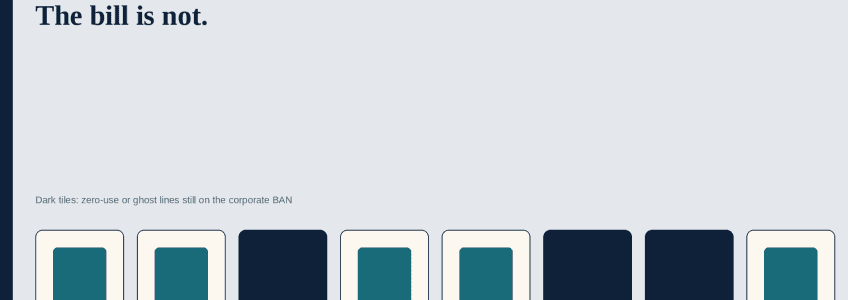
Zero-use mobile lines are corporate numbers that still bill every month after the user, the device, or both have already left. How many mobile lines does your company pay for right now, not approximately, exactly? Most finance teams can’t answer inside a week. RadiusPoint finds those lines by matching the carrier BAN to the HR roster inside ExpenseLogic, then tickets the disconnect so the charge dies.
This is a method page for ex-employee lines and ghost lines. It isn’t a restatement of managed mobility services, and it isn’t a mobility-pillar rewrite.
Key Takeaways
- A food service client of RadiusPoint had 600-plus phones billed with no employee attached. RadiusPoint’s published case cut monthly cost 22%, more than $400,000 a year.
- That same audit found 56 people who were no longer employed, some gone more than two years, with lines still live.
- Registration ran for 60 days on a Register Your Line portal. The pass took two months.
- A Fortune 100 wireless program with RadiusPoint recovered more than $450,000 in refunds and continues to save more than $830,000 a year.
- The HR-Roster Triple Match uses three keys: Employee ID, phone number, and a 0 / 90 / 180 day usage window.
The Short Version
- Load every wireless BAN into ExpenseLogic.
- Match each number to the current HR roster and a device.
- Flag zero-use, ex-employee, and unowned lines.
- Protect system lines (alarm, elevator, POS) before anyone clicks disconnect.
- Suspend, then disconnect, then prove the later invoice is clean.
In this article
- What a zero-use mobile line actually is
- How do you find ex-employee lines still billing?
- The HR-Roster Triple Match
- How are ghost lines different from zero-use lines?
- Lines you should not kill without a second check
- What happens after you submit the disconnect?
- How RadiusPoint and ExpenseLogic retire zero-use lines
What a zero-use mobile line actually is
A zero-use mobile line is a corporate BAN number with no real voice, data, or SMS use in the window you chose. RadiusPoint reads that window from the carrier invoice inside ExpenseLogic, not from a manager’s memory. Zero use is a usage fact. It isn’t yet a kill order. Some quiet lines are spare pool. Some are failover. Some are an employee who left in March.
RadiusPoint’s food service case started with 600-plus phones and no identification of the people using them. That’s the zero-use problem at inventory scale. ExpenseLogic is where the usage column and the Employee ID column finally sit on one row.
A Fortune 100 client brought RadiusPoint about 10,000 wireless devices. At that count, a 1% ghost rate is 100 bills. You won’t find them with a sample.
How do you find ex-employee lines still billing?
You find ex-employee lines by matching every live wireless number to this month’s HR roster, then ticketing every miss. RadiusPoint runs that match in ExpenseLogic against Employee ID first, name second, cost center third. The food service case found 56 identified users who were no longer employed, plus another set of more than 50 lines with no company association. Those are published counts, not a model.
RadiusPoint built a Register Your Line portal for that client. Corporate mailed users and said unregistered lines would cancel after 60 days. The pass took two months because the roster was thin. ExpenseLogic then held the registered set as the inventory of record.
Rogue phones bought at a store and expensed at non-contract rates sat about 30% higher than the corporate plan. RadiusPoint ported those onto the contract. Finding the person is how you find the rate too.
The HR-Roster Triple Match
The HR-Roster Triple Match is RadiusPoint’s three-key test: Employee ID, phone number, and a dated usage window of 0, 90, or 180 days. ExpenseLogic stores the three keys so a miss becomes a typed exception. Mobile-audit blogs say “compare the roster.” They don’t name a three-key test with three usage windows. That’s the first.
| Key | Source RadiusPoint loads | Fail looks like |
|---|---|---|
| Employee ID | Monthly HR feed into ExpenseLogic | Line has a name, ID is termed |
| Phone number | Carrier BAN / invoice | Number on bill, no roster row |
| Usage window | 0 / 90 / 180 days of voice, data, SMS | Zero use, or only background bytes |
Zero days is a same-cycle flag. Ninety days is the default kill-candidate window RadiusPoint uses unless the client policy says otherwise. One hundred eighty days is for seasonal and spare-pool lines you refuse to drop on a quiet quarter. The window is a policy choice. The match isn’t.
How are ghost lines different from zero-use lines?
A ghost line has no living user and no living device, while a zero-use line may still have both and simply sit unused. RadiusPoint codes the two failures separately in ExpenseLogic because the next action differs. An ex-employee line has a person to collect a handset from. A ghost line has a BAN row and a shrug. The food service case had lost devices still billed, in-stock devices billed with no user, and pagers nobody would own. Those are ghosts.
The Fortune 100 wireless case used a Register Your Line database to attach identification codes, cost centers, and Employee IDs. That’s how RadiusPoint turns a ghost into either a named asset or a disconnect. ExpenseLogic keeps the attachment so the ghost can’t reincarnate next quarter.
Craft and other ghost-line essays quote $30 to $55 per unused mobile plan. We aren’t repeating those figures. RadiusPoint’s own published dollars on this problem are the 22% / $400,000 food service outcome and the $830,000 Fortune 100 run-rate.
Lines you should not kill without a second check
You should not kill a quiet line that serves an alarm, elevator, payment terminal, or failover path until someone names the system owner. RadiusPoint puts a system-line hold in ExpenseLogic so a zero-use flag can’t auto-ticket a disconnect. Ghost-line checklists mention alarms. They don’t give you a three-bucket taxonomy next to RadiusPoint’s published 56-person miss.
| Bucket | What ExpenseLogic should show | Default action |
|---|---|---|
| Ex-employee | HR termed, number still billed | Suspend, recover device if you can, disconnect |
| Ghost | No user, no device, no use | Disconnect after a 90-day window |
| System line | Named system, site, and owner | Keep, review annually |
The food service team could not recover some older handsets and let the hardware go. They still killed the service. Hardware loss is a sunk cost. The MRC isn’t.
What happens after you submit the disconnect?
After you submit the disconnect, you still have to prove the later invoices dropped the MRC, or you’ve only filed a hope. RadiusPoint keeps the wireless ticket open in ExpenseLogic through the next two cycles, the same closeout idea used on circuits. A food service line that belonged to someone gone two years had already leaked 24 MRCs. Closing the portal request doesn’t claw those back by itself. A dispute might.
RadiusPoint’s telecom expense management team files those disputes when the LOA allows it. The mobility team tickets the disconnect. ExpenseLogic is the shared record so the two teams don’t close different truths.
Annual line registration is how RadiusPoint stops the pile from growing back. One 60-day pass is a cleanup. A yearly pass is a control.
How RadiusPoint and ExpenseLogic retire zero-use lines
RadiusPoint retires zero-use mobile lines as a managed ExpenseLogic workflow: confirm the bucket, then prove later invoices dropped the MRC. Capabilities already on the mobility page include zero-use identification, ex-employee detection against an HR roster, annual line registration, and invoice allocation to phone number and Employee ID. This page is the method those capabilities execute.
Sharon Watkins built RadiusPoint around invoice truth, not around a dashboard. The food service client had one person who also had other telecom duties. ExpenseLogic plus a named RadiusPoint analyst is how 600-plus lines become a file you can defend.
Capterra listed ExpenseLogic at 4.8 from 31 reviews through December 2025. Amalgam Insights named RadiusPoint a Distinguished Vendor on the 2024 TEM Vendor SmartList. Use those as third-party anchors. Use the 56 and the 22% as the operating anchors.
FAQ
How many months of zero usage before you disconnect?
RadiusPoint defaults to a 90-day window unless your wireless policy says otherwise. Seasonal roles and spare pools can sit on 180 days. Same-cycle zero use is a flag, not a kill.
Can you recover months of charges on an ex-employee line?
Sometimes, if the carrier’s dispute window still covers the tail and the LOA lets RadiusPoint file. The food service lines that had run more than two years were a stop-the-bleeding win more than a full clawback. ExpenseLogic keeps the dates so you know which months are even eligible.
Do tablets and hotspots count as zero-use lines?
Yes. RadiusPoint inventories smartphones, tablets, wearables, and the pagers that still haunt older estates. A quiet hotspot on a closed site is a ghost with a different shape.
Should you suspend first or disconnect immediately?
Suspend first when a device might come back or a legal hold exists. Disconnect when the Triple Match says ghost or termed, and the system-line hold is clear. RadiusPoint writes the choice on the ExpenseLogic ticket.
How does annual line registration prevent ghost lines from returning?
It forces every live number to grow an Employee ID once a year. Unregistered lines age into disconnects. RadiusPoint’s 60-day food service pass is the template. ExpenseLogic holds the registered set so HR changes don’t wait for the next crisis.
What to do before the next wireless bill
Export last month’s BAN and this month’s HR file. If RadiusPoint can’t match them in ExpenseLogic inside a week, you already know the answer to “how many lines do we pay for.”
Latest Updates
- 13 August 2026: Article drafted. 600-plus lines, 22%, $400,000, 56 ex-employees, 60-day window, two-month pass, 30% rogue-rate gap, 50-plus extra lines, Fortune 100 $450,000 refunds and $830,000 annual, 10,000 devices, Capterra 4.8 / 31, Amalgam Insights 2024.
References
- How Managed Mobility Services Cut Costs 22% ($400K in Year 1) | RadiusPoint
- Wireless Expense Management Yields $830K in Annual Savings | RadiusPoint
- Managed Mobility Services | RadiusPoint
- Telecom Expense Management | RadiusPoint
- Sharon R. Watkins | RadiusPoint
- About RadiusPoint | RadiusPoint
- ExpenseLogic reviews | Capterra
Related articles
- Managed Mobility Services
- How Managed Mobility Services Cut Costs 22%
- Telecom Expense Management
Disclaimer
This article is general information for finance, HR, and mobility teams. It is not a promise that every zero-use line can be recovered or disconnected on a set timeline. Outcomes cited are from specific RadiusPoint client engagements already published.