
By Sharon Watkins, Founder and CEO, RadiusPoint · 20 August 2026
Finance teams allocate telecom and utility spend by mapping each service ID to a cost centre, then writing a coded general ledger file. A controller who dumps one billing account number into a catch-all account is coding, not allocating, and the departments will spend the next close arguing about a number nobody can defend.
Cost allocation is the rule that splits a live service across the people and sites that use it, then lands that split in the chart of accounts. GL coding is the last step, not the method. RadiusPoint builds the map inside ExpenseLogic so the file AP posts is already split.
Key Takeaways
- Allocation starts at the service ID (circuit, wireless line, or meter), not at the invoice header or the BAN.
- RadiusPoint can split any charge across multiple cost centres or locations, a live ExpenseLogic FAQ claim.
- ExpenseLogic accounts payable and allocation lists allocation and accrual files as a core AP module, comparable to PeopleSoft and Great Plains interfaces.
- A Fortune 100 manufacturer on RadiusPoint’s published record has more than 10,000 wireless devices managed globally, which is an allocation problem before it is an audit problem.
- Gartner forecast worldwide communications services spend at $1.354 trillion for 2026, up 4.4% from 2025 (Gartner newsroom, 27 July 2026).
The Short Version
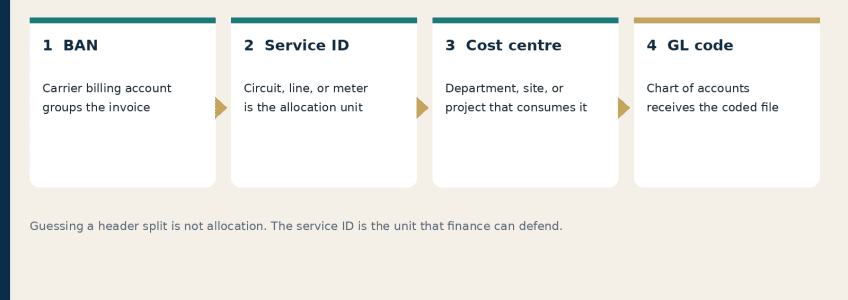
Map every circuit, line, and meter to an owner, apply a written split rule, then export a coded GL file. Do not guess a header percentage after the invoice arrives.
| Step | Unit | What finance gets |
|---|---|---|
| 1. BAN | Carrier account | The invoice envelope |
| 2. Service ID | Circuit, line, or meter | The thing being paid for |
| 3. Cost centre | Department, site, project | Who consumes it |
| 4. GL code | Chart of accounts | Where the file posts |
In This Article
- The Service-ID Allocation Stack
- How do you split one circuit across many cost centres?
- Why does a header split fail at month-end?
- How do you allocate a wireless line after someone leaves?
- Utility Meters Need a Different Grain
- What RadiusPoint Puts in the Interface File
- Frequently Asked Questions
The Service-ID Allocation Stack
Finance allocates recurring spend by stacking four records: billing account, service ID, cost centre, and GL code, in that order. RadiusPoint treats the service ID as the unit because that is what the carrier bills and what the inventory can prove.
ExpenseLogic stores vendors, invoice detail, payment detail, and asset inventory in one portal so the stack does not live in four spreadsheets. The RadiusPoint capability statement names cost allocation and accounting integration as a core competency: rules-based allocation to cost centre, location, and general ledger account, with coded output into the client’s ERP.
A header split (“put 30% of this BAN on marketing”) fails the first time a circuit moves or a store closes. The stack fails later, and it fails with a ticket, because the owner sits on the inventory row.
Education and higher learning are the vertical RadiusPoint already flags for chargeback complexity and manager authorisation workflows. That is the same stack with more cost centres, not a different product.
How do you split one circuit across many cost centres?
You split a shared circuit by writing a percentage rule on the service ID and applying it every cycle until owners change. RadiusPoint’s live TEM FAQ states that any charge can be split between multiple cost centres or locations.
A worked example, invented only as arithmetic on a published capability (circuit split-billing), not as a client result: a $4,800 MPLS circuit used by Finance (25%), Operations (40%), Sales (20%), and an IT backbone share (15%) becomes $1,200 / $1,920 / $960 / $720. The next month uses the same rule unless a MACD ticket changes the owners.
That is chargeback. Chargeback is the conversation with the department. Allocation is the rule that makes the conversation short. RadiusPoint’s telecom expense management lifecycle already lists cost allocation next to invoice audit and payment.
Client growth from 170 to 1,200 locations is a published RadiusPoint scalability proof. At that span, a shared circuit without a written split becomes a monthly argument, not a file.
Why does a header split fail at month-end?
A header split fails at month-end because the BAN no longer matches who used each circuit or meter this period. RadiusPoint will create an upload file that interfaces with the client’s current accounting software for proper allocation, which is the live FAQ answer to “will our AP team key this.”
Coding without a split dumps the BAN into one account and leaves finance to journal the rest. That is the pain the AP director already has: volume, exceptions, manual GL coding, late fees. ExpenseLogic’s AP module is built to remove the keying, not to invent a new chart of accounts.
Gartner’s July 2026 forecast puts worldwide IT spend at $6.37 trillion and communications services at $1.354 trillion (Gartner, 27 July 2026). A 4.4% rise in communications spend is a budget variance problem if last year’s dump account is this year’s “actual.”
Three-way match asks whether the invoice agrees with a purchase order. Allocation asks which cost centre owns a service that never had a purchase order.
How do you allocate a wireless line after someone leaves?
You allocate a departed employee’s wireless line to that person’s last cost centre, then stop the billing and recover leftover months. RadiusPoint’s managed mobility services invoice processing is allocated down to phone number and Employee ID for that reason.
ExpenseLogic can validate a monthly HR roster of valid employee IDs against devices and lines in the repository. That is an allocation control, not a mobility slogan. A food service client on RadiusPoint’s published record had more than 600 lines audited and a 22% cost reduction ($400,000 year one). Those lines had to land somewhere after the audit.
A Fortune 100 wireless discovery story on the same published record shows $830,000 in annual savings. Discovery without allocation just moves the leak into a different GL bucket.
Capterra lists ExpenseLogic at 4.8 from 31 reviews through December 2025 (Capterra, ExpenseLogic). Reviewers who care about AP files care about this grain, not about a dashboard colour.
Utility Meters Need a Different Grain
Utility allocation belongs on the meter number and the site, because one vendor account can hide five meters and a vacant wing. RadiusPoint’s utility expense management (UEM here means Utility Expense Management, not Unified Endpoint Management) allocates cost to location, department, and meter number.
A multi-location RadiusPoint client published $1,500 a month, $18,000 a year, from utilities at closed locations. That finding is an allocation failure first: the meter was still mapped to an open cost centre. This page only needs the grain: meter, not account.
EIA counted 16,529,599 commercial AMI meters in 2024, inside 140,491,981 total AMI installations (EIA Electric Power Annual, Table 10.05). More interval data does not allocate itself. Someone still has to own the meter in the file.
RadiusPoint also houses deposit information by meter and service type, which is another allocation-adjacent record AP rarely sees until a site closes and the deposit never returns.
What RadiusPoint Puts in the Interface File
RadiusPoint delivers a coded upload file on the client’s own chart of accounts, ready for AP to load without re-keying lines. ExpenseLogic writes the spec file to the client’s ERP (PeopleSoft, Great Plains, JD Edwards, and others named on the certifications page) so AP does not re-key.
Sharon Watkins founded RadiusPoint in January 1992 and still treats ExpenseLogic as the place the allocation rule lives. The company’s published posture is software plus people: analysts maintain the inventory so the file stays true after a move.
ISO 9001 certification since September 2002 is the process claim behind a file you can hand an auditor. Amalgam Insights named RadiusPoint a Distinguished Vendor on the 2024 TEM Vendor SmartList. Neither fact is a savings guarantee. Both are reasons the interface file is a product, not a favour.
Ask for one month of invoices allocated at service-ID grain. If the file cannot name the circuit, the line, or the meter, it is a journal entry dressed as TEM.
Frequently Asked Questions
Is GL coding the same as cost allocation?
No. GL coding is the account the journal hits. Allocation is the rule that decides how much of a circuit, line, or meter belongs to each cost centre before that account is chosen. RadiusPoint runs the rule, then writes the code.
Can one circuit hit more than one department?
Yes. RadiusPoint’s live FAQ says any charge can be split across multiple cost centres or locations. The split sits on the service ID so it repeats every cycle until a ticket changes the owners.
Where do wireless lines get charged?
To the phone number and the employee ID, then to that person’s cost centre. Pooled BAN totals cannot survive an offboarding month. ExpenseLogic can test a monthly HR roster against the inventory.
How should utility invoices be allocated?
At meter number and site, not at the vendor account. Utility expense management (not Unified Endpoint Management) is the RadiusPoint name for that grain. Closed-location bills are an allocation miss before they are a recovery project.
What does AP actually receive from RadiusPoint?
An upload file specified during setup, coded to the client’s chart of accounts, so the team does not key invoice lines.
If the File Cannot Name the Circuit, Stop
Allocation that starts at the BAN will be re-litigated every close, because no service ID owns the dollars on that file. Start at the service ID, write the split, export the file.
Request a demo of ExpenseLogic and ask to see one circuit split and one meter coded. Sharon Watkins has been building that file since 1992. The cost of another guessed header is another month of the same argument.
References
- Gartner Forecasts Worldwide IT Spending to Grow 14.2% in 2026, Totaling $6.37 Trillion | Gartner newsroom, 27 July 2026
- Table 10.05. Advanced Metering Count by Technology Type, 2015 through 2024 | U.S. Energy Information Administration
- ExpenseLogic | Capterra
- ExpenseLogic | RadiusPoint
- Telecom Expense Management | RadiusPoint
- Utility Expense Management | RadiusPoint
- Managed Mobility Services | RadiusPoint
- RadiusPoint Capability Statement | RadiusPoint
- Sharon Watkins | RadiusPoint
Related Reading
- ExpenseLogic accounts payable and allocation
- Telecom expense management
- Utility expense management
- RadiusPoint capability statement
This article is educational. RadiusPoint does not guarantee savings, allocations, or close dates. Figures were current as of 28 August 2026.