
Outsourced Telecom Expense Management: What Is It and When to Use It?
Outsourced telecom expense management transfers the operational work of invoice validation, dispute filing, inventory maintenance, and cost allocation to a specialist provider, like RadiusPoint.
While accountability for the budget stays with you. It makes sense when the volume of monthly telecom administration exceeds what your team can staff, which for most organizations happens somewhere above two thousand lines or three hundred circuits.
The decision is rarely about capability.
Internal teams can do this work.
The decision is about whether telecom invoice reconciliation is worth a full-time analyst’s calendar in an organization where that analyst is also the person handling carrier escalations, hardware refresh, and whatever else lands. Outsourcing does not make the work disappear.
It moves the work to a team whose entire day is that work, and whose tooling was built for it.
Your Core Takeaways:
- Outsourcing transfers execution, not accountability. You still own the budget, the carrier relationships and the decisions.
- The honest internal cost includes finance hours, not just telecom hours. Most in-house estimates miss half the labor.
- Inventory build is the hardest part of the transition and the part that determines whether anything else works.
- A named internal owner is non-negotiable. Programs without one underperform regardless of provider quality.
- Judge the provider on days-to-credit and inventory accuracy, not on the size of the first recovery check.
What Outsourcing Actually Transfers, and What It Does Not
Buyers frequently over-scope or under-scope the handoff.
The clean way to think about it is to separate the recurring operational tasks from the decisions and relationships that should stay internal.
| Transfers to the provider | Stays with you |
|---|---|
| Invoice collection, loading and exception handling | Budget ownership and forecast accountability |
| Line-item validation against contracted rates | Approval of disputes above an agreed threshold |
| Dispute filing, tracking and escalation with carriers | Carrier relationship at the executive level |
| Inventory of record maintenance through moves, adds and changes | Decisions to add, disconnect or consolidate services |
| Cost allocation to cost center, location and GL account | Chart of accounts and allocation policy |
| Contract term tracking and renewal alerts | Negotiation strategy and final signature |
Anything in the right column that a provider offers to take is worth scrutinizing.
A provider who negotiates your carrier contracts and also earns a share of the savings is sitting on both sides of a table you should be sitting at.
The In-House Cost Nobody Budgets
Internal comparisons usually count one analyst’s salary and stop. The real cost is distributed, which is exactly why it is invisible on any single cost center.
- Telecom or IT time: invoice review, carrier calls, inventory chasing, disconnect verification.
- Accounts payable time: coding invoices that arrive without allocation, chasing approvals, handling short pays.
- Finance and FP&A time: building accruals from incomplete data, explaining variances after the fact.
- Procurement time: reconstructing contract terms because nobody maintains a rate table.
- Unrecovered error: the disputes that were never filed because the carrier window closed while the invoice sat in a queue.
That last item is the one that changes the business case.
 Carrier dispute windows are finite. An invoice reviewed 60 days late is not a late review; it is a permanent write-off.
Organizations running the process in-house at partial capacity are not saving on labor costs; they are converting them into a recurring leak that never appears as a line item.
In-house telecom expense management does not fail loudly. It fails as a slow accumulation of charges nobody had time to question.
How RadiusPoint Runs an Outsourced Program
RadiusPoint provides outsourced telecom expense management as a fully managed service delivered through ExpenseLogic, its proprietary cloud-based platform.
ExpenseLogic consolidates invoice processing, inventory tracking, and contract management into one configurable system that RadiusPoint analysts operate on the client’s behalf. The service validates one hundred percent of invoice line items against contracted rates, files disputes directly with carriers, maintains the inventory of record through every move, add and change, and delivers allocated cost data into the client’s ERP and accounts payable systems.
RadiusPoint extends the same managed TEM process to wireless and utility invoices, which allows finance and IT leaders to govern telecom, mobility, and facility spend through a single reconciliation workflow rather than three disconnected ones.
The operating distinction is that the analyst work sits with the provider while the reporting and approvals sit with the client.
Clients receive validated invoices, a dispute register with status, an accurate inventory, and allocation output that ties to the general ledger.
They do not receive a queue of exceptions to work through.
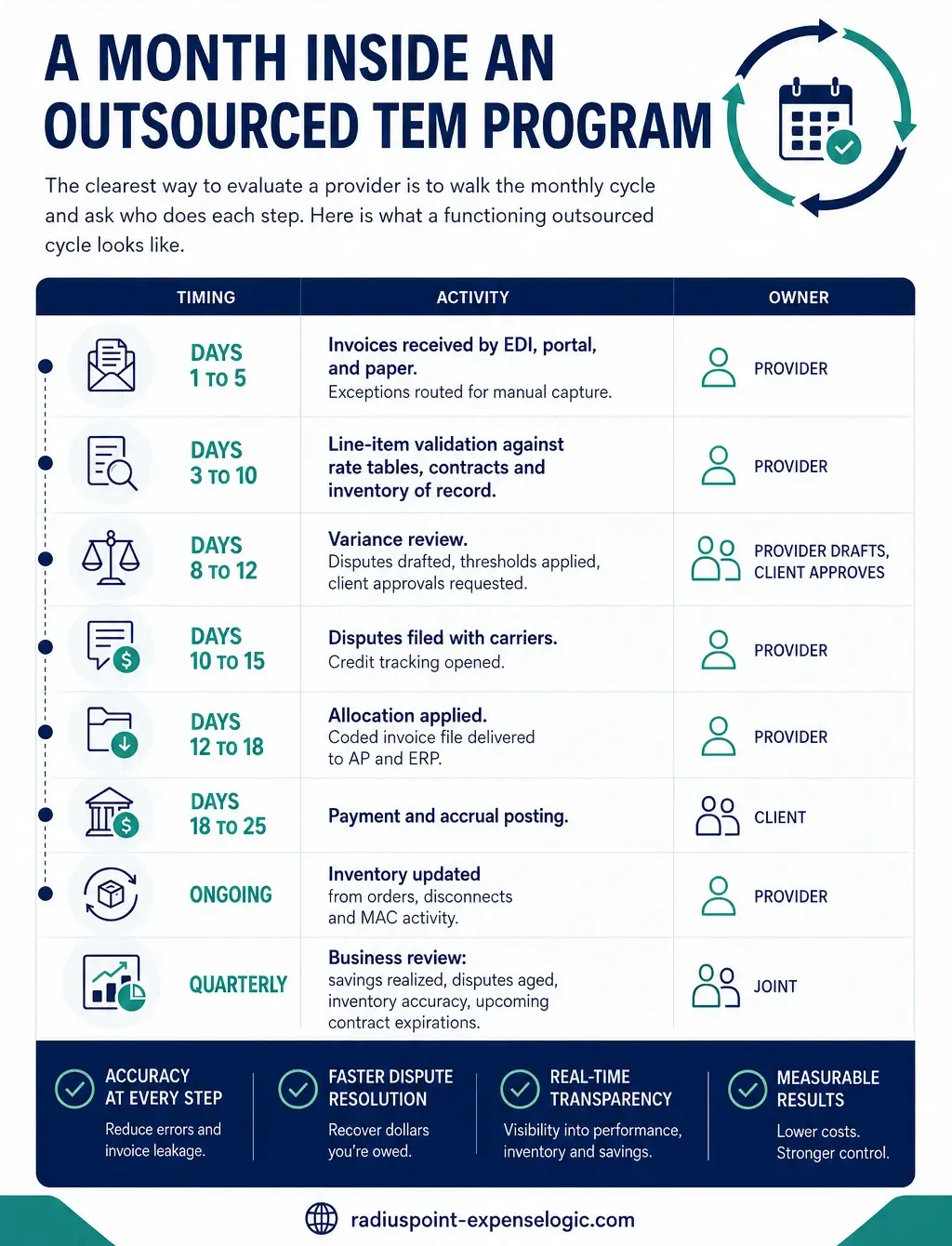
A Month Inside an Outsourced TEM Program
The clearest way to evaluate a provider is to walk the monthly cycle and ask who does each step. Here is what a functioning outsourced cycle looks like. Here we have made a handy infographic to walk you through the month:
 When Outsourcing Is the Wrong Answer
Outsourced telecom expense management is not universally correct, and providers who claim otherwise are worth discounting.
- Your estate is small and stable. Under a few hundred lines with little change activity, a disciplined spreadsheet and one focused hour a month can be adequate.
- You already have a staffed, mature function. If you have analysts who own the process and hit their dispute windows, buy them better software rather than replacing them.
- Your data is too disorganized to hand over, and you will not fund the cleanup. Providers can build the inventory, but not without client participation. A transition the client will not resource produces a program that reports on garbage.
- You are mid-migration. If you are three months from consolidating carriers or replacing your ERP, sequence the transition after the change rather than through it.
- Nobody internally will own it. This is the most common failure and the easiest to predict. Without an accountable owner, vendor output goes unread.
But it is best to consult before you make any decision. To book your call, simply click here.
Building the Business Case
A defensible business case compares three columns, not two.
Comparing outsourcing against a theoretical in-house program that does not exist today is how programs get approved and then underdeliver.
| Factor | Status quo (partial in-house) | Fully staffed in-house | Outsourced managed service |
|---|---|---|---|
| Labor | Distributed across IT, AP and finance, largely uncosted | Dedicated analysts plus software license and training | Provider fee, contractually fixed |
| Validation coverage | Sampling or exception review only | Depends on staffing discipline | Contractually defined, up to full line-item review |
| Dispute timeliness | Frequently outside carrier windows | Good when staffed, degrades with turnover | Governed by service level |
| Inventory accuracy | Degrades continuously | Maintained if resourced | Maintained as part of the service |
| Key person risk | High. One person holds the knowledge. | Moderate | Low. Process and data sit in the platform. |
| Scalability | Breaks at growth or acquisition | Requires new headcount | Absorbs volume change |
Quantify three things and the case largely writes itself: the fully loaded internal hours currently spent, the dollar value of disputes that expired unfiled in the last twelve months, and the variance between what the inventory says you have and what carriers are billing you for.
That third number is usually the one that ends the debate.
Outsourcing, Software, or a One-Time Audit
Outsourcing is one of three ways to address telecom spend, and organizations frequently buy the wrong one because the symptom looks the same from the outside. A rising invoice total can mean billing error, poor inventory hygiene, or simply growth. Each cause points to a different purchase.
| Option | What it solves | What it leaves open | Buy it when |
|---|---|---|---|
| One-time contingency audit | Historical billing errors, recovered as credits | Nothing about next month. The same errors resume. | You need a fast, self-funding proof that error exists |
| TEM software licence | Visibility, structure, a system of record | The labor. Someone still works the exceptions daily. | You have analysts and a process, and they are working in spreadsheets |
| Outsourced managed service | Visibility and the labor, under a service level | Governance. You still need an owner and a review cadence. | The work exceeds your staffing and you want a recurring outcome |
A useful sequencing pattern for organizations that need internal buy-in is to run a contingency audit first, use the recovered dollars as evidence of the size of the problem, and then move to a managed program before the same errors reaccumulate. The mistake is stopping after the audit, banking the refund, and treating a one-time recovery as a control.
Security, Compliance and Data Handling
Handing invoice and inventory data to a third party pulls in procurement and information security, and the review goes faster if you raise these items early rather than at contract stage.
- Employee data in mobility records. Wireless inventories contain names, device identifiers and sometimes location data. Confirm what the provider stores, for how long, and under which privacy basis.
- Independent assurance. Ask for a current SOC 2 Type II report or equivalent, and read the exceptions section rather than the cover page.
- Data residency and subprocessors. Establish where invoice data is processed and stored, and whether any part of validation is subcontracted offshore.
- Access model. Role-based access, single sign-on support, and a documented offboarding process for provider analysts who leave the account.
- Letters of authorization. Scope them to invoice access and dispute filing. A blanket letter of authorization that permits ordering or disconnecting services is broader than the service requires.
- Exit and portability. Named export formats for inventory, rate tables, contract records and dispute history, with a defined transition assistance period.
What Good Looks Like in Year One, Two and Three
Expectations set badly are the second most common reason outsourced programs get judged as failures. The value curve is not flat, and it does not peak where most business cases assume it does.
| Period | What is happening | What to measure |
|---|---|---|
| Months 1 to 6 | Inventory build, carrier account setup, rate table construction, first validated cycles | Percentage of invoices under management, inventory completeness, not savings |
| Months 6 to 12 | Historical error surfaces and disputes are filed in volume. Recovery peaks. | Disputed dollars filed, days to credit, first credits landing |
| Year 2 | Recovery falls because the estate is cleaner. Avoidance becomes the main value. | Cost avoided against baseline, inventory accuracy rate, contract renewals caught before expiry |
| Year 3 and beyond | Steady state. Value comes from optimization, disconnects and negotiation support. | Spend per line trend, unused service elimination, forecast accuracy |
Falling recovery in year two is a sign of success, not decline, and a business case that projects year-one recovery levels indefinitely will make a healthy program look like it is regressing. Write the avoidance baseline down in month one, while everyone still agrees what the starting position was.
Choosing a Provider to Outsource TEM
The outsourced segment includes generalist business process outsourcers, telecom-specific managed service providers, and software vendors offering a services wrapper.
Names that appear in this space include Valicom, E78 Partners, Socium, Bearstone, Lightyear and RadiusPoint, alongside the larger platform vendors covered in our guide to telecom expense management companies. Independent research from Gartner Peer Insights and benchmarks published by AOTMP are useful for understanding segment fit, and broader outsourcing research such as the Deloitte Global Outsourcing Survey is a reasonable frame for the governance side of the decision.
Weight your evaluation toward evidence rather than positioning.
Ask for a redacted dispute register. Ask for the inventory accuracy rate across their book of business. Ask to speak to a client who has been live for more than two years and has been through a carrier billing platform migration. Then read our overview of telecom expense management for the underlying discipline, and see how the economics played out for a manufacturer that moved from in-house review to a managed program.
Frequently Asked Questions
What does outsourced telecom expense management include?
It typically includes invoice collection and loading, line-item validation against contracts, dispute filing and tracking with carriers, inventory of record maintenance, cost allocation to cost centers and GL accounts, and reporting. Scope varies by provider, so confirm each item in the contract rather than the proposal.
Is outsourcing telecom expense management cheaper than doing it in-house?
It depends on the honest internal cost, which includes finance and accounts payable hours, not only telecom hours, plus the value of disputes that expire unfiled. Organizations running the process at partial capacity usually find outsourcing costs less than the leak it stops. Organizations with a fully staffed, disciplined function often do better buying software.
Do we lose control of our carrier relationships?
You should not. Well-structured programs keep contract negotiation, disconnect decisions, and executive carrier relationships with the client. The provider operates within those decisions and files disputes under a letter of authorization.
How long does it take to transition to an outsourced provider?
Three to six months is typical for an enterprise estate, and the majority of that time goes to building an accurate inventory rather than to software setup. Shorter timelines usually mean inventory reconciliation was deferred.
What internal resource do we still need?
One named owner who reviews provider output, approves disputes above an agreed threshold, and runs the quarterly business review. Expect a few hours a month, not a role.
Can an outsourced provider handle wireless and utility bills too?
Some can. Consolidating fixed telecom, mobility and utility invoices with one provider removes duplicate reconciliation across IT, finance and facilities. RadiusPoint manages all three through ExpenseLogic on a single platform.
What happens to our data if we change providers?
Your inventory, rate tables, contract records and dispute history should be contractually portable in a defined export format. Confirm this before signing, because reconstructing an inventory of record a second time is the single most expensive part of switching.
How quickly should we expect savings?
Recovery from historical billing errors often appears in the first two quarters, since it depends on auditing invoices already issued. Ongoing avoidance builds more slowly and depends on inventory accuracy reaching a stable state. Treat any projection that front-loads both as optimistic.
Supplier Compliance: How Businesses Stop Vendor Overbilling
Every organization has compliance obligations. Fewer recognize that their vendors have them too, and that when suppliers fall short, the financial consequences land directly on your balance sheet.
Supplier compliance is the practice of ensuring that vendors, service providers, and third-party partners adhere to the rates, terms, and standards they contractually agreed to deliver.
In telecom, utility, and IT expense management, supplier non-compliance takes the form of billing errors, unauthorized charges, and services billed long after they were discontinued.
For mid-market and enterprise organizations managing hundreds of vendor invoices monthly, the cumulative cost of unchallenged non-compliance routinely runs into six and seven figures annually.
The financial case for enforcing supplier compliance is direct: enterprises recover 12 to 18 percent of annual telecom spend through systematic invoice auditing alone, according to industry benchmarks.
Yet the majority of organizations still review invoices for payment rather than accuracy, leaving non-compliant charges to compound unchallenged month after month.
The Compliance Obligation Runs Both Ways
Most discussions of supplier compliance focus on the obligations you owe your vendor ecosystem, such as procurement standards, ESG reporting requirements, and diversity initiatives. That matters. RadiusPoint takes it seriously, and you can learn more about our supplier diversity commitments here.
But there is an equally consequential direction that finance and operations leaders routinely overlook: the compliance your suppliers owe to you.
When your organization negotiates a telecom contract, every rate, every service level, and every billing term represents a binding commitment. When your utility provider bills a meter at a location you closed 14 months ago, that is a compliance failure.
When your wireless carrier continues charging $85 per line for a former employee’s device that was never formally disconnected, that is a compliance failure. When a circuit is billed at a pre-negotiated rate that your carrier quietly increased mid-contract, that is a compliance failure.
The distinction is critical. Supplier compliance is not just about vetting who you do business with. It is about holding the vendors you already use accountable to what they agreed to provide.
Where Supplier Non-Compliance Hides in Plain Sight
Across telecom, mobility, and utility spend categories, billing non-compliance follows predictable patterns. Understanding them is the first step toward enforcing accountability.
| Non-Compliance Type | Common Cause | Financial Impact |
|---|---|---|
| Ghost device billing | Lines not disconnected after employee departure | 85to85to200/month per line, compounding |
| Rate non-compliance | Carrier billing pre-negotiated rates incorrectly | 5 to 15% overbilling on affected circuits |
| Zero-use service charges | Services active but unused for 90+ days | Thousands annually in unnecessary spend |
| Closed-location utility billing | Meters are still active after site closure | Up to $18,000 in annual avoidable costs |
| Duplicate circuit charges | Multi-account billing errors by the carrier | Direct overpayment, often undetected |
A Fortune 100 paper manufacturer working with RadiusPoint discovered exactly this pattern at scale. Post-audit, the organization recovered 450,000 in telecom refunds in the first year alone, with ongoing annual savings of with ongoing annual savings of 850,000 once non-compliant charges were eliminated and contract terms were enforced. Total Year 1 impact: $1.3 million, recovered from spend that finance had been approving as accurate for years.
Four Levers for Enforcing Supplier Compliance
Effective supplier compliance enforcement in expense management requires more than a periodic invoice review. It demands a structured framework that operates continuously across every vendor, every service line, and every location.
1. Line-item invoice auditing
Every invoice line must be validated against contracted terms before payment is approved. This means cross-referencing rates, quantities, and service configurations against your current inventory and active agreements. Manual processes miss the volume and detail required at enterprise scale. Automated platforms catch discrepancies in real time, flagging exceptions for dispute before they are paid.
2. MACD ticketing discipline
Move, Add, Change, and Disconnect requests are the most common source of supplier non-compliance in wireless expense management. When a device is reassigned or an employee exits without a formal disconnect order, the billing continues. A rigorous MACD process creates a documented chain of custody for every service change, preventing unauthorized charges from ever reaching an invoice.
3. Contract compliance monitoring
Supplier agreements expire, rates escalate through contractual fine print, and promotional terms lapse on schedules that vendors track far more carefully than their clients do. Continuous contract management means your negotiated rates are audited against actual billing throughout the contract lifecycle, not just at renewal.
4. Usage validation against active inventory
Zero-use device identification is one of the most direct expressions of supplier compliance enforcement. If a service is being billed but generating no usage, the vendor is collecting payment for nothing. Regular usage analysis, tied to an accurate device inventory, surfaces these charges systematically rather than accidentally.
How RadiusPoint Enforces Supplier Compliance at Scale
RadiusPoint’s proprietary platform, ExpenseLogic, was built to operationalize supplier compliance enforcement across telecom, managed mobility, and utility spend simultaneously. Rather than treating each expense category as a separate problem, ExpenseLogic provides a unified view that connects inventory, contracts, invoices, and usage data into a single compliance framework.
For wireless programs, ExpenseLogic tracks devices by serial number and Employee ID, running automated zero-use identification against active billing to surface non-compliant charges before payment clears. MACD ticketing is managed within the platform, creating an auditable record that prevents disconnect requests from falling through the cracks that carriers then exploit.
For utility spend, ExpenseLogic performs meter-level line-item audits that pinpoint non-compliant billing to specific locations, including sites that have been closed. One multi-location client using this capability identified 1,500 per month in utility charges tied to locations no longer in operation, recovering 18,000 annually from spend that had been treated as legitimate for years.
The financial outcomes are measurable and consistent. RadiusPoint clients achieve average cost reductions of 15 to 30 percent in the first year, with ROI ranging from 370 to 580 percent, backed by a 100 percent client retention rate that reflects what enforceable supplier compliance delivers in practice.
Leaving Supplier Compliance Unenforced has Consequences
Organizations that continue reviewing invoices for payment rather than accuracy are, in effect, treating supplier non-compliance as a budget line item. Every month that a non-compliant charge goes unchallenged is a month that costs recovery becomes harder to pursue, and financial leakage continues compounding.
The choice is direct: continue absorbing charges that vendors were never entitled to collect, or implement a supplier compliance framework that holds every invoice to the standard your contracts already guarantee.
RadiusPoint has recovered more than $1.3 million in a single year for individual clients by enforcing the supplier compliance terms that were already in place. The contracts existed. The obligations were documented. What was missing was the systematic enforcement that transforms compliance language into actionable business intelligence.
Request a demo to see how RadiusPoint enforces supplier compliance across your telecom, utility, and mobility spend, and find out what your vendors owe you that they have not yet delivered.

Category Management: How Enterprises Reduce Hidden Spend
Finance approved the budget. Procurement signed the contracts. The invoices arrive every month, get paid, and get filed. And somewhere inside that routine, organizations are losing between 15% and 30% of their total telecom, utility, and IT spend to errors, unused services, and zero-use accounts that no one has audited in years.
That is the category management problem most enterprises refuse to name. Not because it is complicated, but because it is invisible.
Effective category management for telecom, utility, and IT expenses consolidates scattered vendor data into a single, auditable framework that identifies cost leakage, enforces procurement policy, and recovers overpayments before they compound. Organizations that apply structured category management to these spend areas achieve 10% to 20% savings on total procurement costs, according to GAO analysis of leading private-sector companies. The ones that do not continue absorbing losses that show up nowhere on a performance review.
The Spend Categories Most CFOs Cannot Fully Explain
Telecom, utilities, and IT assets are some of the largest indirect spend categories in any multi-location enterprise. They are also the least transparent. Finance sees a lump-sum payment. IT sees a circuit ID. Procurement sees a renewal date. None of them is looking at the same data, which means none of them is catching the same problems.
The data on what this costs is not abstract. Research shows that 27% of enterprise telecom spend goes to unused services, duplicate circuits, and contracts that were never formally terminated. A separate analysis found that 85% of telecom invoices contain billing errors, averaging a 7% to 12% overcharge per invoice. On a 2 million annual telecom budget, that range translates to between 2 million annual telecom budget, that range translates to between 140,000 and $240,000 in preventable overpayments every year.
Utility spend has its own version of this problem. Organizations pay for services at closed locations for months, sometimes years, before anyone notices. A single audit uncovering utilities billed against a facility that shut down 18 months earlier is not an edge case; it is a pattern that repeats across industries.
The common thread is a lack of category-level visibility. When telecom, mobility, and utilities are managed as separate billing functions rather than unified spend categories, cost leakage compounds silently.
What Category Management Actually Requires in These Spend Areas
Category management is not simply reviewing invoices quarterly. It is a structured approach to treating each spend type as a managed asset class with defined ownership, lifecycle controls, and performance benchmarks. For telecom, IT, and utility expenses, that requires four interconnected capabilities.
| Capability | What It Addresses | Financial Impact |
|---|---|---|
| Inventory and asset tracking | Unknown or unmapped services, ghost devices, and zero-use accounts | Eliminates 15% to 20% of spend on zombie lines and unused circuits |
| Line-item invoice auditing | Billing errors, duplicate charges, and rate discrepancies | Recovers 12% to 18% of annual spend through refund recovery |
| Contract lifecycle management | Auto-renewals at outdated rates, expired terms, and missed renegotiation windows | Achieves 18% to 25% savings at renewal through data-driven leverage |
| Cost allocation and chargeback | Inability to assign expenses to specific locations, departments, or cost centers | Enables accurate budgeting and flags maverick spend |
Most organizations have partial versions of one or two of these capabilities. The gap between partial and complete is where the financial leakage lives.
Where Fragmented Category Management Fails at Scale
The scale problem is not hypothetical. A global paper manufacturer managing 10,000 wireless devices across multiple countries faces a category management challenge that a manual process or a single-point solution cannot address. The team responsible for those lines has no reliable inventory of which devices belong to active employees, which are sitting in a drawer charged to a corporate plan, and which are flagged to former employees who left 18 months ago.
That specific gap, ex-employee phones still on active plans, is one of the most common cost recovery opportunities RadiusPoint identifies during initial audits. It is also one of the easiest to prevent with proper MACD ticketing, which governs the Move, Add, Change, and Disconnect requests that should trigger account changes whenever an employee joins or leaves the organization.
Without MACD controls embedded in the category management framework, procurement teams authorize purchases that never get decommissioned. The device goes silent. The billing continues. And the category manager has no visibility into the discrepancy because the inventory data and the invoice data live in different systems.
The same dynamic applies to utility management. Vacant unit cost recovery, where an organization recaptures utility expenses from locations that have become unoccupied, requires both the inventory data to identify the location status and the audit capability to match it against the invoice. Without both, the cost sits unrecovered.
How RadiusPoint Delivers Category Management as a Strategic Function
RadiusPoint platform was built specifically to eliminate the fragmentation that makes category management fail at the enterprise level. Rather than offering separate tools for telecom, mobility, and utilities, ExpenseLogic consolidates all three into a single platform with shared inventory data, unified invoice processing, and granular cost allocation down to the meter number, phone number, and employee ID.
This unified architecture closes the gaps that fragmented point solutions leave open. Auditors working within ExpenseLogic can cross-reference an invoice line item against the device inventory in real time, identify a zero-use account, and initiate a disconnect without switching systems. The same workflow that flags a billing error on a wireline circuit can trigger a refund dispute with the carrier, track the resolution status, and post the recovery to the correct cost center.
For procurement and finance leaders who need category-level reporting, the platform produces exception reports and budget comparisons that surface anomalies before they become entrenched costs. A client in the food service industry used this approach to audit 600 wireless lines, establish a formal procurement policy, and reduce wireless costs by 22%, recovering $400,000 in year one. A healthcare provider managing multiple facilities achieved a 26% reduction in telecom expenses through the same combination of centralized oversight and line-item auditing.
These results are consistent with what structured category management delivers when the underlying data is clean, unified, and actionable. The Ardent Partners CPO Rising 2025 report found that fewer than 10% of organizations have fully automated their spend categorization. The other 90% are managing these expense categories with tools and processes that were never designed to catch what ExpenseLogic catches by default.
RadiusPoint’s commitment to supplier diversity also informs how the company approaches vendor management within the category management framework. Organizations that prioritize diverse and certified supplier relationships gain additional leverage in negotiations and compliance reporting, both of which are strengthened by the contract and vendor visibility that ExpenseLogic provides.
The Cost of Waiting
Category management for telecom, utility, and IT spend is not a long-term transformation project. It is a structured process that begins generating returns within the first year. RadiusPoint clients see an average return on investment ranging from 370% to 580%, with cost reductions of 15% to 30% in year one.
The cost of inaction is specific and compounding. Every billing cycle that passes without a line-item audit is another cycle of paying for services no one uses, at rates no one has benchmarked, on contracts no one is actively managing. For a mid-market organization spending 1 million annually on telecom and utilities, a conservative 151 million annually on telecom and utilities, a conservative 15150,000 in recoverable costs sitting unclaimed each year.
That is not a line item. That is a budget decision. Organizations that treat telecom, IT, and utility expenses as managed categories rather than recurring overhead stop absorbing those losses. The ones that do not continue paying for the invisible.
Request a demo of RadiusPoint to see exactly where your category spend is leaking, and what a structured audit and management framework would recover in year one.

What Is a Supplier Audit? How Businesses Stop Hidden Spend
A procurement director at a regional manufacturing firm spends three hours reconciling telecom invoices across 47 locations. She flags what looks like a discrepancy on two data circuits, works through the carrier’s billing department over six weeks, and recovers 11,000. She has no idea the same carrier has been double-billing a disconnected circuit for 14 months. By the time it surfaces, 28,000 is gone.
That is not a billing department failure. That is a supplier audit gap.
A supplier audit is a systematic, line-item review of what your vendors, carriers, and service providers are actually charging you versus what you contractually agreed to pay. For mid-market and enterprise organizations managing telecom, mobility, IT, and utility expenses across multiple locations, a structured supplier audit is how organizations recover the 15-30% of spend they never knew they were losing, and prevent it from disappearing again.
What a Supplier Audit Actually Reveals
The standard definition of a supplier audit focuses on quality, compliance, and supply chain performance. That scope matters for manufacturers and procurement teams evaluating product inputs. But for finance, IT, and operations leaders managing vendor-heavy expense environments, the more consequential form of supplier audit is the financial one: validating that every invoice from every provider reflects actual contracted rates, active services, and accurate usage.
Telecom, utility, and mobility vendors operate complex billing systems that generate errors regularly. Industry research shows that nearly 73% of enterprise telecom invoices contain billing discrepancies, contract mismatches, or charges for disconnected services. For organizations spending $ 1 million annually on telecom alone, that translates to $ 80,000 to $150,000 in identified billing errors per audit cycle.
The categories of financial leakage that a supplier audit surfaces include:
- Ghost services: Lines, circuits, and devices still billed after disconnection or employee departure
- Contract non-compliance: Carriers billing at non-contracted rates or failing to apply negotiated discounts
- Zero-use charges: Mobile lines with no activity are being invoiced at full plan rates
- Duplicate billing: The same service is invoiced twice across consolidated statements
- Tax and surcharge errors: Incorrectly applied fees, exemptions not honored, or rates charged against the wrong tariff
Each of these categories carries a dollar value. Identifying them is the first output of a supplier audit. Recovering them and preventing recurrence is where the real financial impact is realized.
Where Financial Leakage Hides in Multi-Location Organizations
The complexity of vendor billing scales with organizational size. A company operating 50 locations across five states manages dozens of carrier relationships, hundreds of utility accounts, and potentially thousands of mobile devices. At that scale, no internal team processing invoices manually can catch every error in every billing cycle.
Consider a scenario common in the healthcare sector: a hospital network acquires two outpatient facilities. The IT team migrates services. The old carrier contracts are not formally terminated. Twelve months later, finance is still paying $4,200 per month for circuits at locations that have been consolidated. No one flagged it because no one was reconciling invoice data against the current inventory of active services.
RadiusPoint’s healthcare clients have recovered an average of 26% in telecom expense reductions through this kind of multi-site oversight and centralized management. The savings are not the result of renegotiating contracts. They come from auditing what vendors are actually billing against what the organization should be paying.
The same pattern appears in utility expense management. A multi-location retail or property management organization pays utility bills for dozens of sites monthly. When a location closes or a tenant vacates, utility accounts frequently remain active and continue generating charges. RadiusPoint’s Utility Expense Management (UEM) service has identified utility payments at closed locations costing organizations 1,500 per month, totaling 1,500 per month, totaling 18,000 annually in avoidable spend.
The Four Pillars of an Effective Supplier Audit
A supplier audit for operational expenses must cover four interconnected areas to deliver measurable recovery and long-term cost control.
1. Inventory Validation
Every service being invoiced must be matched to an active, documented service record. This means building a centralized inventory of every telecom line, wireless device, data circuit, and utility account, then reconciling that inventory against current invoices. Orphaned services with no corresponding active record represent immediate recovery opportunities.
2. Contract Reconciliation
Every charge must be validated against the specific contract governing that service. This requires maintaining a current contract library for every vendor, tracking rate schedules, discount structures, term commitments, and expiration dates. Contract audits routinely uncover 15-25% in recoverable spend from out-of-contract billing and missed discount applications.
3. Usage Analysis
Contracted services must be evaluated against actual usage. Zero-use mobile lines, underutilized data circuits, and oversized utility plans represent ongoing waste that usage analysis identifies and eliminates. RadiusPoint’s Managed Mobility Services (MMS) deploys zero-use device identification to find and disconnect lines generating no activity but continuing to bill at full plan rates.
4. Dispute Management and Recovery
Identifying errors is necessary but insufficient. Recovering funds requires working directly with vendors to dispute incorrect charges, file refund claims, and ensure corrections are applied to future invoices. This is where internal teams without dedicated vendor relationships and billing expertise consistently fall short.
Why Manual Supplier Audits Fail at Scale
Organizations with dedicated finance and procurement staff often believe they are managing supplier billing adequately. The assumption is reasonable. The reality is that telecom and utility billing systems are specifically complex, and carriers have limited incentive to correct errors that benefit them.
A Fortune 100 paper manufacturer that engaged RadiusPoint had six people processing invoices delivered in a three-foot-high box every month. Despite that resource investment, line-item errors, ex-employee phone charges, and unauthorized service add-ons had accumulated across the portfolio. Year-one results after implementing a structured supplier audit process through RadiusPoint’s ExpenseLogic platform: 450,000 intelecom refunds, 850,000 in ongoing annual savings, and $1.3 million in total Year 1 financial impact.
The difference between manual processing and a managed supplier audit is not effort. It is methodology, tooling, and vendor-side expertise. Software-only audit approaches miss 40-60% of the total error value because complex errors require human judgment, contract interpretation, and carrier relationship knowledge that automated systems cannot provide.
How RadiusPoint Structures Supplier Audits Across Telecom, Mobility, and Utility Spend
RadiusPoint’s approach to supplier auditing integrates its proprietary ExpenseLogic platform with a dedicated managed services team, covering the full lifecycle of vendor expense from invoice receipt through payment and dispute resolution.
The ExpenseLogic platform provides a centralized dashboard that consolidates telecom, mobility, and utility invoice data across all vendor relationships. Every invoice is processed with line-item granularity, validated against contracted rates, and flagged for exceptions before payment clears. MACD Ticketing (Move, Add, Change, Disconnect) prevents unauthorized service additions and ensures that disconnections are properly reflected in billing, eliminating the ghost service problem at the source.
For wireless and mobility environments, RadiusPoint audits every device by serial number and Employee ID. Annual line registration maintains a clean inventory, while zero-use identification finds and eliminates plans’ billing for inactive devices. Food service clients have seen 22% monthly cost reductions, totaling $400,000 in Year 1, after RadiusPoint audited 600-plus wireless lines and established and enforced procurement policies.
Utility expense management extends the same audit discipline to electricity, gas, water, and waste accounts. Meter-level auditing validates every utility charge against actual consumption, identifies billing errors at the account level, and flags services at closed or consolidated locations. For property management organizations, RadiusPoint’s Vacant Cost Recovery (VCR) service specifically recovers utility costs from accounts that remain active after tenant transitions.
Clients across RadiusPoint’s portfolio achieve an average return on investment ranging from 370% to over 580%, with 15-30% cost reductions delivered in the first year. The 100% client retention rate reflects what sustained supplier audit discipline delivers: not a one-time recovery exercise, but ongoing, compounding savings built on visibility and control.
As a certified women-owned business with ISO 9001 and SSAE 18 certifications and recognition in the Gartner Market Guide for Telecom Expense Management Services, RadiusPoint brings 30-plus years of specialized expertise to every client engagement. Organizations committed to supplier diversity as a procurement principle will find a vendor that reflects those values in both certification and practice.
The Cost of Leaving a Supplier Audit Undone
Every billing cycle without a structured supplier audit is a billing cycle where errors accumulate, ghost services persist, and contract non-compliance goes unchallenged. For an organization spending 2million annually across telecom, mobility, and utility vendors, industry errorrates suggest 2 million annually across telecom, mobility, and utility vendors, industry error rates suggest 300,000 to $600,000 in avoidable costs may be flowing out annually.
The choice is not between managing expenses and not managing them. It is between absorbing those losses and recovering them. Organizations that treat supplier auditing as a strategic function, rather than a periodic accounting exercise, consistently outperform those that rely on internal manual review to catch what carriers, utilities, and mobility vendors routinely overbill.
Request a demo of ExpenseLogic and see how RadiusPoint’s managed supplier audit framework transforms scattered vendor billing data into actionable business intelligence, recovers historical overcharges, and prevents financial leakage from recurring.

Sustainable Sourcing Is Failing Without Spend Visibility: What Your Invoices Are Hiding
A procurement director at a multi-site manufacturing company presents her sustainability report to the board. Carbon emissions from operations are down 14%. Supplier ESG scorecards are current. The company’s net-zero roadmap is on slide four. Then the CFO asks a single question: how much are you spending on utilities across all 47 locations this quarter? She does not know. Nobody does. The data lives in 23 different invoices, processed manually by a two-person accounts payable team, with no line-item reconciliation against contracted rates.
This is the gap that derails sustainable sourcing programs before they deliver results. Organizations invest heavily in ESG strategy, supplier auditing, and carbon reduction commitments, yet the operational infrastructure required to measure, verify, and sustain those commitments is missing entirely. Sustainable sourcing is not a policy problem. It is a data and visibility problem, and the cost of that gap is measurable.
Sustainable Sourcing vs. Traditional Procurement
Sustainable sourcing integrates environmental, social, and governance (ESG) criteria into every purchasing decision, moving beyond price and availability to evaluate a supplier’s carbon footprint, labor practices, and regulatory compliance. But that definition understates how different the operational demands are. Traditional procurement asks one question: did we get what we paid for, at the price we negotiated? Sustainable sourcing asks five.
| Dimension | Traditional Sourcing | Sustainable Sourcing |
| Primary Criteria | Price, availability, quality | Price + ESG credentials + lifecycle cost |
| Emissions Accountability | Scope 1 and 2 only | Scope 1, 2, and 3 (supply chain) |
| Supplier Evaluation | Price bids and delivery track record | ESG scorecards, audits, carbon data |
| Spend Visibility | Purchase order level | Invoice, meter, and line-item level |
| Risk Horizon | Immediate supply continuity | Regulatory, reputational, and operational |
| Cost Recovery Potential | Negotiated unit price only | 5-30% through billing audits and waste elimination |
The shift from traditional to sustainable sourcing is most visible at the invoice level. ESG procurement requires organizations to know what they are actually consuming across telecom, IT, and utilities, not just what the purchase order says. Without that granular, line-item visibility, Scope 3 emissions reporting is guesswork, and cost recovery from billing errors is zero.
Why Sustainable Sourcing Initiatives Stall
ESG is officially the #2 priority for procurement executives heading into 2025, according to a study by the Economist and SAP. More than half of B2B companies in both the U.S. and Europe have announced net-zero goals. Yet 40% of those organizations are now required to report and reduce Scope 3 emissions, which are embedded in their entire value chain, including every utility provider, telecom carrier, and technology vendor they source from.
That reporting requirement exposes a structural problem. Most mid-market and enterprise organizations do not have centralized visibility into their operational spend at the granularity required for credible ESG reporting. Telecom bills arrive from dozens of carriers. Utility invoices span hundreds of meters across dozens of locations. Wireless device lines continue billing for ex-employees who left months ago. None of this shows up in a purchase order system or a supplier ESG scorecard. It shows up as financial leakage, inflated carbon footprint data, and regulatory exposure.
The consequences are not abstract. Research from McKinsey shows that strong ESG execution can reduce operational costs by 5 to 10%. But capturing that reduction requires eliminating the sources of waste first, and most organizations cannot identify what they are paying for with enough specificity to know what to cut.
| Pain Point | Operational Consequence | Financial Exposure |
| No utility spend visibility | Cannot report or reduce Scope 3 emissions from energy use | Paying for services at closed locations; avg. $18K annual waste |
| Zero-use device lines | Ghost assets inflate carbon footprint reporting | $85/line/month in undetected charges for ex-employee devices |
| Manual invoice processing | Billing errors go undetected; no ESG audit trail | Telecom overcharges average 7-12% of total spend |
| Fragmented vendor data | No centralized view of supplier ESG performance | Missed refund recovery; Fortune 100 clients recover $450K+ in Year 1 |
The Three Spend Categories Undermining Your ESG Commitments
Utility Spend: The Blind Spot in Carbon Reporting
Utility expense management is where sustainable sourcing programs face their most significant credibility risk. Energy, water, gas, and waste services generate the consumption data that feeds carbon accounting. Organizations reporting Scope 3 emissions without meter-level visibility into actual consumption are, at best, estimating. At worst, they are misrepresenting their environmental footprint to stakeholders and regulators.
The EU’s Corporate Sustainability Reporting Directive (CSRD) requires detailed, verifiable sustainability disclosures starting in 2025. In the U.S., SEC proposed climate-related disclosure rules are reshaping how publicly traded companies report emissions. Non-compliance is no longer a theoretical risk. Organizations that cannot produce auditable utility consumption data by location, meter, and cost center are exposed. RadiusPoint clients using utility expense management through ExpenseLogic have identified $18,000 in annual savings simply by detecting payments for utilities at locations that had already closed, a common failure in organizations managing dozens of sites without centralized tracking.
Telecom and Wireless: Ghost Assets That Inflate Your Footprint
Every active phone line attached to a zero-use device is a liability on two balance sheets: financial and environmental. Organizations with 500 or more wireless devices routinely carry 8 to 15% of their lines in a state of non-use, provisioned for employees who have since departed, reassigned, or never activated their devices. Those lines generate billing charges of approximately $85 per line per month while contributing nothing to operations and distorting asset inventory data.
For sustainable sourcing, the problem compounds. Accurate supplier relationship data, MACD ticketing (Move, Add, Change, Disconnect), and device lifecycle management are foundational to responsible procurement. Without them, organizations cannot enforce procurement policies, cannot validate which technology vendors are actually delivering contracted services, and cannot quantify the true cost of their communications infrastructure. A Fortune 100 paper manufacturer working with RadiusPoint recovered $450,000 in telecom refunds in the first year alone, with $1.3 million in total Year 1 impact, by identifying billing errors and ghost device charges that had gone undetected for years.
IT Asset Management: Where Sustainability Meets Lifecycle Accountability
Technology assets that are not tracked by serial number across their full lifecycle create two problems for sustainable sourcing. First, organizations lose visibility into vendor contract compliance, paying rates that no longer reflect current agreements. Second, asset disposal and replacement cycles cannot be optimized for environmental impact without knowing what exists, where it is, and when contracts expire. Information technology asset management (ITAM) bridges ESG commitment and operational reality by converting scattered device data into actionable business intelligence.
From Scattered Data to Sustainable Strategy: How RadiusPoint Closes the Gap
RadiusPoint’s ExpenseLogic platform consolidates telecom, wireless, utility, and IT asset expense management into a single, cloud-based system. For organizations building or scaling a sustainable sourcing program, this centralization is not a convenience. It is a prerequisite.
Line-item audit capability within ExpenseLogic validates every invoice against contracted rates, identifies billing errors, and flags zero-use lines before they accumulate into six-figure annual charges. Clients typically achieve 15 to 30% cost reduction in the first year, with an average ROI of 370 to 580%. Those savings do not come from renegotiating contracts. They come from eliminating the financial leakage that invisibility creates.
Meter-level utility tracking provides the granular consumption data required for credible Scope 3 emissions reporting. By allocating utility costs down to the location, department, or cost center level, procurement and sustainability teams gain the verified data they need to identify reduction opportunities, benchmark performance, and produce the kind of auditable ESG reports that regulators and investors increasingly require.
MACD Ticketing and device lifecycle management prevent unauthorized purchases, enforce wireless procurement policies, and ensure that offboarding processes actually deactivate device lines rather than leaving them to bill indefinitely. For organizations managing 500 or more wireless devices, this is where sustainable sourcing policy becomes operational reality.
ERP and accounts payable integration connects ExpenseLogic’s expense data directly to financial systems, enabling real-time accrual files, budget comparisons, and exception reporting. For CFOs and procurement leaders responsible for ESG financial reporting, this integration converts the promise of spend visibility into auditable, board-ready data.
The Cost of Waiting Is Already on Your Invoices
Organizations pursuing sustainable sourcing face a straightforward choice. Continue absorbing the 7 to 12% in undetected telecom overcharges, the utility payments flowing to closed locations, and the ghost device lines that inflate both operational costs and environmental footprint data. Or implement the spend visibility infrastructure that makes ESG commitments verifiable, defensible, and financially self-funding.
RadiusPoint has delivered $830,000 in annual savings to Fortune 100 clients through wireless optimization alone. A global glass manufacturer achieved 200% ROI on TEM services in the first year. A healthcare provider reduced telecom expenses by 26% across multiple sites through centralized management. These are not cost-cutting exercises. They are the operational foundation that makes sustainable sourcing credible.
With Gartner recognition as a Representative Vendor in the Telecom Expense Management market, RadiusPoint brings 30 years of specialized expertise to the visibility gap that is holding back sustainable sourcing programs across industries.
Request a demo of RadiusPoint to calculate your savings potential and build the spend visibility infrastructure your ESG program requires.
How Beazer Homes Achieved Over $1 Million in Annual Savings with RadiusPoint
Discover how a top 100 U.S. homebuilder partnered with RadiusPoint to eliminate operational waste, accelerate home delivery, and establish a new benchmark for construction efficiency through a technology-enabled shared services model.
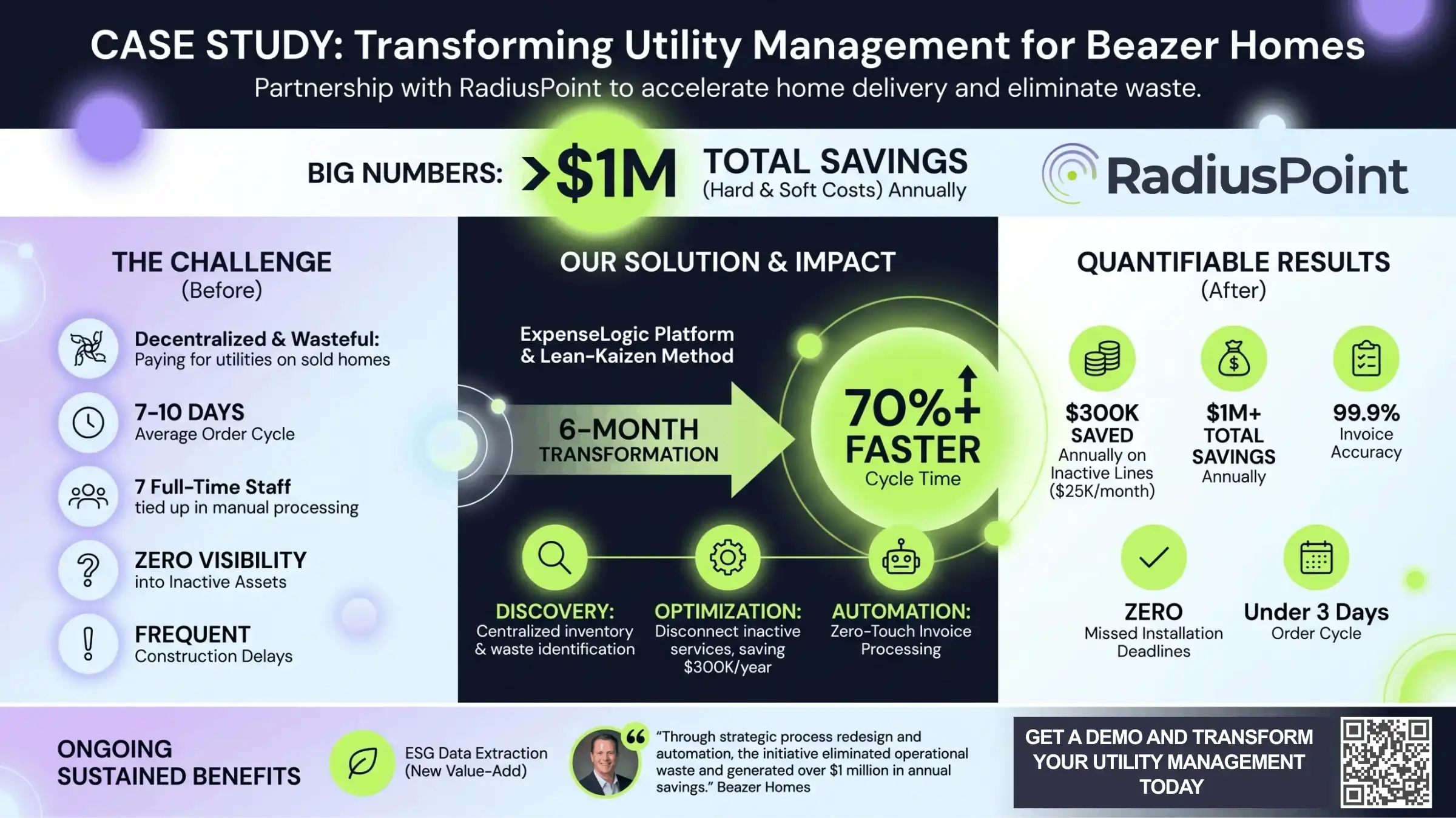
Beazer Homes, one of the top 100 homebuilders in the United States, was grappling with a decentralized and inefficient utility service management process. This system created significant financial leakage, operational burdens, and construction delays that impacted the delivery of 5,000 new homes annually.
By partnering with RadiusPoint, Beazer Homes undertook a strategic transformation, leveraging the ExpenseLogic platform and a shared services model to centralize and automate its entire utility service lifecycle.
The initiative delivered transformative results, proving that strategic automation can drive immense value and sustainable bottom-line improvements in the construction sector.
Key Metrics at a Glance:
- Over $1,000,000 in Annual Cost Savings ($83,000 per month)
- $300,000 in Annual Hard-Dollar Savings from Disconnected Inactive Services ($25,000 per month)
- Cycle Time Reduced by Over 70%
- 99.9% Invoice Processing Accuracy
- Zero Missed Installation Deadlines
The Client: A National Leader in Homebuilding
Beazer Homes stands as a pillar in the U.S. homebuilding sector, dedicated to creating quality homes and communities. Operating across multiple divisions nationwide, the organization builds approximately 5,000 new homes every year. As a top 100 builder, Beazer Homes operates with a profound focus on operational efficiency and customer satisfaction.
Every dollar saved and every day reduced in the construction timeline directly contributes to the company’s core mission: delivering exceptional homes to buyers on schedule.
This commitment to excellence was the driving force behind its decision to address long-standing operational inefficiencies in utility management.
The Challenge: A Fractured System Undermining Construction Timelines
Before partnering with RadiusPoint, Beazer Homes’ approach to managing utility services for new builds was fragmented and manual. Lacking a centralized system, the organization faced a cascade of challenges that created a significant financial and operational drag.
1. Crippling Operational Inefficiency
The baseline process required 7 to 10 days of manual effort from multiple teams across the U.S. to order or disconnect utilities for new home builds. Without a centralized repository, tracking orders was impossible. This caused duplication, rework, and wasted labor hours, especially when staff changed. The workload consumed the equivalent of seven full-time staff members across multiple offices.
2. Construction Delays and Frustration
Builders, frustrated by delays, often placed incorrect utility orders themselves. This resulted in service disruptions and direct construction delays. These inefficiencies conflicted directly with the business priority to improve efficiency, reduce overhead, and accelerate home delivery.
3. Severe Financial Leakage
The decentralized process was rife with uncontrolled spending. With multiple divisions ordering services for each house, invoices were frequently misdirected. This resulted in service disconnections and work disruptions. Furthermore, the company was using Concur, which lacked the necessary invoice detail and payment functionality to manage utility expenses effectively.
4. Lack of Visibility on Inactive Services
With no central database, Beazer Homes had no clear view of its utility assets after a home was sold. Sold properties were often still being billed and paid for each month, leading to substantial and unnecessary financial waste.
The Solution: A Strategic Partnership for End-to-End Transformation
RadiusPoint introduced a comprehensive, technology-enabled shared services solution designed to address Beazer Homes’ challenges from the ground up.
This was not merely a software installation but a strategic partnership focused on redesigning processes, aligning technology, and empowering people.
The core of the solution was RadiusPoint’s proprietary ExpenseLogic platform, which served as the engine for automation and centralization.
The multi-faceted solution included:
- End-to-End Invoice Lifecycle Automation: RadiusPoint assumed full responsibility for Beazer Homes’ utility invoice lifecycle. The ExpenseLogic platform automated everything from invoice receipt and processing to validation and payment. This eliminated manual check creation and mailing by client staff.
- Centralized Order and Inventory Management: All requests for new services or disconnections were centralized through ExpenseLogic. The team developed an automated workflow for ordering, approvals, and real-time builder interaction through prefilled digital forms. This reduced time, confusion, and errors.
- Comprehensive Audit and Cost Optimization: A new disconnect process was implemented to prevent payments for sold properties. This immediate identification and disconnection of inactive services yielded significant hard-dollar savings.
- Advanced Analytics and ESG Data Extraction: The ExpenseLogic platform provided real-time visibility into order status, invoice processing, and cost analytics. Additionally, the automation platform enabled ESG (Environmental, Social, and Governance) data extraction from invoices, an unforeseen value-add that enhanced reporting and compliance capabilities.
RadiusPoint Methodology: A Framework for Lasting Change
RadiusPoint’s success was underpinned by a hybrid Lean-Kaizen methodology. This dual approach focused on Lean principles to identify and eliminate non-value activities (waste) and Kaizen principles to foster a culture of continuous, team-driven improvement.
The implementation followed a structured six-month roadmap, ensuring a smooth transition without disrupting critical operations.
A cornerstone of the methodology was a robust change management and stakeholder engagement strategy.
RadiusPoint recognized that technology alone is not enough. To ensure adoption and long-term success, they focused on winning the trust of key stakeholders.
- Overcoming Resistance: Resistance from regional staff, who feared automation would cause missed installations, was addressed through hands-on training and pilot testing. By highlighting how automation would reduce workload and improve accuracy, the project team reassured them that technology was an enabler, not a replacement.
- Building Internal Champions: The builder operations teams quickly became the strongest supporters. As they experienced faster service activations and fewer delays, their positive feedback and testimonials drove broader acceptance among other departments.
- Data-Driven Communication: Visual dashboards showing “before and after” efficiency metrics helped reinforce the benefits. Messaging was tailored to each group: executives focused on ROI and governance, while staff communications emphasized workload reduction and process clarity.
The Results: A New Standard for Construction Efficiency
The partnership delivered results that exceeded all initial targets, creating a powerful ripple effect across the entire Beazer Homes organization.
| Metric | Before Transformation | After Transformation with RadiusPoint | Impact |
|---|---|---|---|
| Annual Cost Savings | Uncontrolled Overhead | Over $1,000,000 | Massive reduction in operational waste and labor costs. |
| Inactive Service Savings | Paying for Sold Homes | $300,000 Annually | $25,000 monthly hard-dollar savings from disconnecting sold properties. |
| Order Cycle Time | 7 to 10 Days | Under 3 Days | Over 70% reduction, eliminating construction delays. |
| Invoice Processing Accuracy | Prone to Human Error | 99.9% | Near-perfect accuracy, ensuring financial integrity. |
| Installation Deadlines | Frequent Misses | Zero Missed Deadlines | Seamless service activations improving the builder experience. |
Beyond these impressive numbers, the initiative transformed Beazer Homes’ operational culture. It fostered a commitment to continuous improvement and established a repeatable framework for automation-driven process enhancement.
This success has not only strengthened Beazer Homes’ financial position but has also solidified its ability to deliver on its core mission of building quality homes on schedule.
Client Impact:
“The RadiusPoint-Beazer Homes Process Improvement and Value Creation initiative exemplifies shared services innovation at its best, leveraging technology, teamwork, and continuous improvement to deliver measurable business value. Through strategic process redesign, automation, and stakeholder collaboration, the initiative eliminated operational waste, enhanced the builder experience, and generated over $1 million in annual savings.”
RadiusPoint Project Team
Transform Your Organization’s Potential into Performance
Beazer Homes’ story is a powerful testament to what is possible when a leading organization embraces strategic automation.
If your organization is facing similar challenges with expense management, RadiusPoint can help.
Ready to see how much you could save?
- Schedule a Demo – Get a personalized tour of the ExpenseLogic platform.
- Contact Sales – Speak with one of our experts to discuss your specific needs.

ESG Procurement: Closing the Gap Between Sustainability Goals and Purchasing Decisions
Two-thirds of the average company’s environmental, social, and governance footprint lies with its suppliers, not within its own four walls. Yet according to McKinsey research, only 20% of chief procurement officers use sustainability measures as primary criteria in sourcing decisions. Less than 10% include ESG in their category strategies. The result is a massive blind spot: organizations publicly commit to net-zero targets and ethical supply chains while the function that controls 60-80% of corporate spend operates largely disconnected from those commitments.
For CFOs, CIOs, and procurement leaders managing complex telecom, IT, and utility expenses across multiple vendors and locations, this disconnect is not abstract. Every invoice processed, every contract renewed, and every vendor selected either advances or undermines an organization’s ESG position. The question is no longer whether procurement should integrate ESG principles. It is how quickly your organization can close the gap between stated goals and actual purchasing behavior.
ESG Procurement Explained: Beyond Compliance to Competitive Advantage
ESG procurement is the practice of selecting and managing suppliers based not only on price, quality, and delivery timelines but also on their environmental impact, social responsibility, and corporate governance standards. The framework evaluates three interconnected pillars. The Environmental pillar addresses carbon emissions, energy consumption, waste reduction, and sustainable sourcing. The Social pillar covers ethical labor practices, supplier diversity, fair wages, community impact, and human rights due diligence. The Governance pillar examines transparency, regulatory compliance, anti-corruption policies, data security, and responsible decision-making.
ESG is not a rebranding of Corporate Social Responsibility (CSR). While CSR focused primarily on philanthropy and voluntary self-regulation, ESG introduces measurable, data-driven performance metrics that investors, regulators, and stakeholders increasingly use to evaluate organizational risk and long-term viability. According to PwC research, 83% of investors now consider ESG performance a key factor in investment decisions.
ESG Procurement vs. Traditional Procurement
| Dimension | Traditional Procurement | ESG Procurement |
| Decision Criteria | Cost, quality, delivery speed | Cost, quality, delivery plus environmental impact, social responsibility, governance standards |
| Supplier Evaluation | Financial stability and performance metrics | Financial stability plus carbon footprint, labor practices, diversity certifications, compliance history |
| Risk Assessment | Supply disruption and price volatility | Supply disruption plus regulatory penalties, reputational damage, Scope 3 emissions exposure |
| Reporting | Cost savings and contract terms | Cost savings plus ESG scorecards, diverse spend percentages, carbon accounting data |
| Strategic Value | Cost reduction function | Strategic driver of sustainability, resilience, and stakeholder trust |
Why ESG in Procurement Is No Longer Optional
The pressure to embed ESG into procurement is converging from multiple directions simultaneously. Regulatory bodies across the globe are introducing mandatory due diligence requirements. The EU’s Corporate Sustainability Reporting Directive (CSRD), Corporate Sustainability Due Diligence Directive (CSDDD), and the IFRS S2 climate disclosure standard all create overlapping requirements for companies to collect supplier ESG data, evaluate value chain risk, and disclose climate-related information. In the United States, the SEC’s climate disclosure rules and state-level regulations are expanding reporting obligations for publicly traded companies.
The financial stakes are concrete. Scope 3 emissions (indirect emissions from a company’s value chain, including purchased goods and services) represent the largest share of most organizations’ carbon footprints. CDP and Boston Consulting Group report that corporate supply chain emissions are, on average, 26 times higher than operational emissions. For most products, 80-90% of greenhouse gas emissions are Scope 3, and two-thirds of those originate from upstream suppliers. Organizations that cannot measure, report, and reduce these emissions face growing exposure to regulatory penalties, investor scrutiny, and competitive disadvantage.
According to Deloitte’s 2023 CPO Survey, ESG has become the second-most important objective for chief procurement officers, rising from sixth place in 2021. Yet the EcoVadis Sustainable Procurement Barometer 2024 reveals a significant execution gap: while 50% of mainstream programs use integrated ESG data to inform stakeholders, only 30% of ESG integrations into procurement processes are reported as “very or extremely effective.” Digital integration of ESG data (via API, for example) averages just 10% across procurement processes.
Five Pillars of an Effective ESG Procurement Strategy
- Spend Visibility and Supplier Mapping. You cannot manage what you cannot measure. Effective ESG procurement begins with granular visibility into where every dollar goes, which vendors receive it, and what services or products they provide. This requires centralized expense management that captures spend by vendor, by category, by location, and by cost center. Without this foundation, ESG reporting becomes guesswork rather than governance.
- Supplier ESG Scorecards and Due Diligence. Leading organizations now evaluate suppliers using carbon scorecards alongside traditional KPIs for cost, quality, and delivery. This includes collecting data on environmental policies, labor practices, diversity certifications, and governance documentation during onboarding and at regular intervals. About 67% of supplier diversity leaders now rely on third-party data providers, reflecting growing pressure for accurate, auditable ESG reporting.
- Scope 3 Emissions Tracking. Purchased goods and services (Category 1 under the GHG Protocol) typically account for 35-40% of total Scope 3 emissions. Procurement teams are the primary interface for collecting this data from suppliers, whether through supplier-specific methods, hybrid approaches, or spend-based calculations. Major corporations including Salesforce, Nestlé, and Walmart now require suppliers to set science-based targets and report emissions data as a contractual obligation.
- Supplier Diversity as a Social Pillar. ESG’s social dimension intersects directly with supplier diversity. Partnering with certified minority-owned, women-owned, veteran-owned, and LGBTQ+-owned businesses demonstrates measurable social impact. Companies with active supplier diversity programs generate a 133% greater return on procurement investments, and 94% of organizations with these programs report increased client attraction or retention. Supplier diversity is no longer a standalone initiative; it is a core ESG metric.
- Technology-Enabled Reporting and Compliance. Manual ESG tracking through spreadsheets creates audit risks and reporting gaps. Modern procurement platforms automate supplier ESG data collection, flag compliance issues, and generate reports aligned with frameworks like SASB/ISSB, GRI, and CDP. About 66% of organizations now use supplier diversity management systems, and AI tools can scan thousands of public data sources to identify suppliers linked to human rights issues, sanctions, or poor environmental records.
Where ESG Procurement Meets Telecom, IT, and Utility Expense Management
For organizations managing hundreds of telecom lines, thousands of mobile devices, and utility accounts spanning dozens of locations, ESG procurement is not an abstract framework. It is a practical challenge embedded in every invoice. Telecom and utility vendors are part of the supply chain. Their environmental practices, labor standards, and governance compliance contribute to an organization’s Scope 3 footprint. Every overcharged invoice, every ghost device billing $85 per month to a disconnected line, and every unreconciled utility account represents not just financial leakage but also a gap in ESG data integrity.
Centralized Telecom Expense Management (TEM), Managed Mobility Services (MMS), and Utility Expense Management (UEM) platforms provide the spend visibility that ESG procurement demands. Line-item auditing identifies exactly where dollars flow across the vendor landscape. Contract management tracks which agreements include ESG provisions and which are due for renewal. Asset tracking by serial number, phone number, and employee ID creates the granular data layer needed for accurate Scope 3 calculations and supplier ESG assessments.
Consider the utility expense dimension specifically. Meter-level auditing and consumption cost allocation enable organizations to measure energy usage by location and department, directly feeding into carbon accounting requirements. Identifying payments for services at closed locations (which can reach $18,000 or more annually) eliminates not just wasted spend but also inaccurate emissions calculations tied to phantom consumption data.
How RadiusPointAdvance ESG Procurement Objectives
RadiusPoint delivers the spend visibility, vendor accountability, and cost optimization that ESG procurement strategies require. As a certified women-owned business operating since 1992, RadiusPoint contributes directly to the social pillar of ESG through every client engagement, with procurement dollars spent on RadiusPoint services counting toward supplier diversity targets.
RadiusPoint consolidates TEM, MMS, and UEM into a single cloud-based dashboard. The platform tracks expenses by vendor, by phone number, by meter number, and by employee ID, providing the granular spend data that ESG reporting frameworks demand. Line-item audits across wireline, wireless, and data circuits catch billing errors and overcharges that distort both financial and emissions data. Zero-use device identification eliminates ghost devices still billing monthly, removing phantom spend that inflates Scope 3 calculations.
The financial results reinforce the strategic case. RadiusPoint clients achieve average ROI of 370% to over 580%, with typical cost savings of 15-30% in the first year. A Fortune 100 manufacturer recovered $450,000 in telecom refunds in year one and $850,000 in ongoing annual savings, totaling $1.3 million in first-year impact across 10,000+ wireless devices globally. RadiusPoint’s 100% client retention rate, 99% client satisfaction score, and 5.0 Gartner Peer Insights ratings confirm that ESG-aligned procurement does not require sacrificing service quality or financial performance. ISO 9001 certification (since 2002) and SSAE 18 compliance provide the governance assurance that enterprise procurement teams and auditors require.
Stop Choosing Between Cost Savings and ESG Compliance
Organizations managing complex telecom, IT, and utility expenses face a false choice: optimize costs or advance ESG goals. The reality is that both objectives depend on the same foundation, which is granular spend visibility, vendor accountability, and centralized data management. Every billing error caught is simultaneously a cost recovery and a data correction. Every ghost device eliminated reduces both financial waste and inaccurate Scope 3 reporting. Every dollar spent with a certified women-owned expense management provider advances supplier diversity metrics.
RadiusPoint transforms expense management from a chore into a strategic advantage, delivering 15-30% cost reduction and 370-580% ROI while strengthening the ESG data infrastructure your stakeholders, investors, and regulators increasingly demand. Request a demo of RadiusPoint to see how unified expense management can reduce costs and advance your ESG procurement strategy simultaneously.

Supplier Diversity: What It Means, Why It Matters, and How It Strengthens Your Supply Chain
Your procurement team just renewed a $2 million telecom contract with the same carrier you have used for the past decade. The rates are 12% above market average. The service level agreement has not been renegotiated since 2019. And three qualified vendors, including two certified minority-owned businesses with competitive pricing and stronger SLAs, never received an invitation to bid.
This scenario plays out across industries every quarter, costing organizations millions in missed savings while simultaneously narrowing the vendor pipeline that fuels innovation and competition. The solution is not just better sourcing. It is a structured approach to supplier diversity that transforms procurement from a transactional function into a strategic growth engine.
Supplier Diversity Definition
Supplier diversity is a proactive business strategy that ensures procurement processes include businesses owned and operated by individuals from historically underrepresented groups. A diverse supplier is typically defined as a business that is at least 51% owned and controlled by an individual or group from a traditionally marginalized demographic. These categories include minority-owned business enterprises (MBEs), women-owned business enterprises (WBEs), veteran-owned small businesses (VOSBs), service-disabled veteran-owned businesses (SDVOSBs), LGBTQ+-owned enterprises, disability-owned businesses, and Small Business Administration (SBA) designated small businesses.
Certification through recognized third-party organizations validates a supplier’s diverse status. The National Minority Supplier Development Council (NMSDC) certifies minority-owned businesses. The Women’s Business Enterprise National Council (WBENC) certifies women-owned firms. These certifications create a verified pipeline of qualified vendors that purchasing organizations can engage with confidence.
Supplier Diversity vs. Supply Chain Diversification
| Dimension | Supplier Diversity | Supply Chain Diversification |
| Primary Goal | Include businesses owned by underrepresented groups in procurement | Reduce risk by spreading sourcing across multiple vendors and regions |
| Focus | Ownership demographics and certification status | Geographic, operational, and vendor concentration risk |
| Business Impact | 133% greater ROI on procurement, 20% lower buying operations cost | Reduced disruption risk, improved continuity planning |
| Measurement | Diverse spend as percentage of total procurement spend | Number of suppliers per category, geographic distribution |
The Financial Case for Supplier Diversity Programs
Organizations that treat supplier diversity as a strategic initiative, rather than a regulatory obligation, consistently outperform those that do not. Companies with active supplier diversity programs generate a 133% greater return on procurement investments compared to those without such programs. Organizations prioritizing diverse sourcing report 20% lower spending on buying operations, driven by increased competition among qualified vendors.
The numbers at an industry level reinforce this trend. Direct spending of $168 billion with small and diverse suppliers has produced a wider economic impact of $303 billion, meaning every dollar spent with a diverse supplier generates $1.80 in broader economic value. These programs collectively support more than 710,000 direct jobs and contribute $60 billion in wages, with an additional 1.4 million indirect jobs accounting for $105 billion in total income.
Yet most organizations are still in the early stages. According to Supplier.io, companies spend an average of only 3.6% of procurement budgets with certified diverse suppliers. The best-in-class average reaches 9.1%, but 80% of companies spend less than 5%. This gap represents a significant opportunity for procurement leaders willing to build structured programs.
Five Core Components of an Effective Supplier Diversity Strategy
Executive Sponsorship and Cross-Functional Ownership.
Supplier diversity programs that report only to procurement often stall. According to the 2024 State of Supplier Diversity Report, 71% of businesses now consider these programs more important than ever, but 36% still face a lack of buy-in from key stakeholders. Effective programs require visible executive commitment and shared accountability across procurement, finance, operations, and compliance teams.
Certified Supplier Pipeline Development.
Building relationships with certification bodies (NMSDC, WBENC, National Veteran Business Development Council, National LGBT Chamber of Commerce, Disability:IN) creates a verified source of qualified vendors. About 74% of organizations now collect diversity certifications from their suppliers, and 66% use supplier diversity management systems to track and manage these relationships.
Spend Analysis and Goal Setting.
Measurement starts with understanding current procurement spend by category, supplier, and diversity classification. Organizations should track diverse spend as a percentage of total procurement, the number of diverse suppliers engaged, year-over-year growth, and Tier 2 subcontractor diversity. Clear, measurable targets (for example, increasing diverse spend from 5% to 10% within two years) provide direction and accountability.
Tier 2 Program Integration.
Tier 2 reporting extends diversity requirements to prime contractors, asking them to report their own spend with diverse subcontractors. This multiplies the impact of diversity initiatives across the entire supply chain without requiring the purchasing organization to manage every vendor relationship directly.
Technology-Enabled Tracking and Reporting.
Manual tracking through spreadsheets creates data gaps and compliance risks. Modern supplier diversity management platforms automate certification verification, flag expiring certifications, and generate real-time dashboards. About 78% of businesses now produce internal supplier diversity reports, and 48% share external reports with stakeholders.
Where Supplier Diversity Meets Expense Management
For organizations managing complex telecom, IT, and utility expenses across multiple vendors and locations, supplier diversity intersects directly with procurement optimization. Every invoice processed, every contract negotiated, and every vendor relationship managed represents an opportunity to align spending with diversity goals.
Consider the procurement lifecycle for telecom and utility services. Organizations with 500+ wireless devices or 50+ telecom lines typically manage dozens of vendor relationships. Each contract renewal, each new service order, and each vendor evaluation is a touchpoint where diverse suppliers can be considered. The challenge is visibility. Without centralized expense management, procurement teams cannot accurately measure current spend, identify which vendors qualify as diverse, or track progress toward diversity targets.
This is where Telecom Expense Management (TEM), Managed Mobility Services (MMS), and Utility Expense Management (UEM) platforms become critical infrastructure. A unified expense management platform provides the granular spend data, by vendor, by service category, by location, that supplier diversity reporting requires. Line-item audits reveal exactly where dollars flow. Contract management databases show which agreements are up for renewal and where diverse vendors could compete.
How RadiusPoint Support Supplier Diversity Goals?
RadiusPoint operates as a certified women-owned business, meaning that every dollar a client spends on RadiusPoint’s managed services and ExpenseLogic platform counts directly toward supplier diversity spend targets. For organizations tracking diverse procurement metrics, this transforms expense management from a cost center into a dual-purpose investment: reducing telecom, mobility, and utility costs by 15-30% in the first year while simultaneously advancing supplier diversity commitments.
It’s proprietary cloud-based SaaS platform (now in its 8th generation, version 9.70), delivers the granular spend visibility that supplier diversity programs demand. The platform consolidates TEM, MMS, and UEM into a single dashboard, tracking costs by vendor, by phone number, by meter, and by employee ID. This level of detail enables procurement teams to generate accurate diversity spend reports segmented by service category and vendor classification.
RadiusPoint’s track record validates this approach. The company maintains a 100% client retention rate and 99% client satisfaction score, with 5.0 ratings on Gartner Peer Insights. Clients experience average ROI of 370% to over 580%, with documented results including $1.3 million in first-year savings for a Fortune 100 manufacturer, $830,000 in annual wireless optimization savings, and 22% cost reductions through managed mobility audits. The company holds ISO 9001 certification (since 2002), SSAE 18 certification, and a GSA Schedule 70 IT Contract, reinforcing the compliance and quality standards that enterprise procurement teams require.
Turn Procurement Spend into Strategic Advantage
Organizations managing hundreds of telecom, IT, and utility vendor relationships face a choice. Continue absorbing six-figure losses from billing errors, zero-use devices, and unoptimized contracts while leaving supplier diversity targets unmet. Or partner with a certified women-owned expense management provider that delivers 15-30% cost reduction and 370-580% ROI while advancing every dollar spent toward measurable diversity goals.
RadiusPoint transforms expense management from a chore into a strategic advantage. Request a demo of RadiusPoint to see how centralized spend visibility, line-item auditing, and managed services can reduce costs and strengthen your supplier diversity program simultaneously.

Supplier Relationship Management: How Enterprise Organizations Stop Leaking Money Through Vendor Blind Spots
The procurement director at a mid-sized manufacturing company sat across from three department heads, each holding a different invoice from the same telecom vendor. The amounts varied. The line items did not match prior contracts. No one could confirm which services were actually in use. The meeting ended with a task force and no resolution.
This is not an edge case. It is the default state of supplier relationships for organizations managing dozens or hundreds of vendors without centralized oversight. Fragmented data, siloed teams, and reactive contract management are not just operational inconveniences. They are the direct cause of measurable financial leakage that compounds every quarter.
Supplier relationship management (SRM) is the structured discipline of evaluating, engaging, and optimizing vendor partnerships across the full procurement and expense lifecycle. For mid-market and enterprise organizations, a mature SRM program is the difference between absorbing avoidable costs and recovering them.
Why Most Vendor Relationships Fail to Deliver Financial Value
The common assumption is that once a contract is signed, the relationship manages itself. That assumption is expensive.
According to CAPS Research, the supply management function achieved an average return on investment of 731% in 2024 through cost avoidance and reduction. Yet the majority of organizations are not capturing that return because their SRM processes remain fragmented, manual, or entirely absent. A 2023 study published in Sage Journals found that supplier collaboration has a statistically significant positive effect on competitive advantage, yet only 26% of procurement professionals rate maximizing supplier relationship value as a top priority.
The gap between potential and realized value comes down to visibility. Without centralized supplier data, organizations routinely overpay for services they no longer use, miss contract renewal windows that lock in unfavorable terms, and fail to identify billing errors that repeat month over month. For organizations managing telecom, IT, and utility vendors at scale, this financial leakage is not measured in thousands of dollars. It is measured in six and seven figures annually.
The Four Pillars of Effective Supplier Relationship Management
1. Supplier Segmentation and Strategic Classification
Not every vendor warrants the same level of engagement. Effective SRM begins with segmenting suppliers by strategic value, spend volume, risk exposure, and business impact. The Kraljic Matrix is a widely used framework for this, classifying suppliers as strategic, leverage, bottleneck, or non-critical based on profit impact and supply risk.
For telecom, IT, and utility vendors specifically, this segmentation is particularly important. A single wireline provider delivering data circuits to 40 locations is not a transactional vendor. It is a strategic dependency. Managing it with the same process as a one-time office supply purchase creates both operational and financial risk.
| Supplier Tier | Management Approach | Review Frequency |
| Strategic | Executive sponsorship, joint planning, co-development | Monthly |
| Leverage | Competitive bidding, performance tracking, volume optimization | Quarterly |
| Bottleneck | Risk mitigation planning, redundancy evaluation | Quarterly |
| Non-Critical | Automation, standardized process, minimal oversight | Annually |
2. Invoice Validation and Line-Item Auditing
Billing errors in telecom and utility invoices are not occasional. Industry data consistently shows that between 7% and 12% of all telecom invoices contain errors, overcharges, or charges for services that were disconnected or never activated. For an organization spending $2 million annually on telecom, that represents $140,000 to $240,000 in preventable costs.
Effective SRM embeds line-item audit processes into the standard invoice workflow. Each invoice is validated against contracted rates, active service records, and historical usage. Discrepancies trigger dispute workflows. Identified overcharges become refund recovery actions.
This is not a one-time cleanup. It is an ongoing operational function that requires both technology infrastructure and dedicated expertise to execute consistently.
3. Contract Lifecycle Management and Rate Optimization
Supplier contracts carry expiration dates, rate escalation clauses, and auto-renewal provisions that organizations routinely miss. A contract that renews automatically at outdated rates is a recurring cost that compounds over time.
Contract lifecycle management within an SRM framework tracks every agreement by vendor, service type, term length, and renewal date. It audits invoiced rates against contracted terms on an ongoing basis. When contracts approach renewal, it triggers renegotiation workflows before auto-renewal locks in unfavorable terms.
For organizations with dozens of active vendor agreements, this process cannot be managed manually without significant resource strain and the near-certain outcome of missed windows.
4. Zero-Use and Defunct Service Identification
One of the most underestimated sources of financial waste in enterprise supplier management is payment for services no one is using. Ex-employee phone lines continue generating monthly charges long after offboarding. Data circuits billed to closed locations sit in payment queues with no one flagging the discrepancy. Utility accounts at vacated properties continue to run.
These are not hypothetical scenarios. A Fortune 100 manufacturer engaged RadiusPoint and discovered ex-employee phones and unauthorized app downloads across a portfolio of 10,000 wireless devices. The financial recovery in year one reached $1.3 million, combining $450,000 in telecom refunds with $850,000 in ongoing annual savings.
The Cost of Fragmented Supplier Management at Scale
Organizations that manage vendor relationships reactively, one invoice at a time, across siloed departments, share a predictable set of outcomes.
Finance teams spend hours each month manually processing invoices that should be automated, comparing charges against contracts that are not centrally stored. IT teams discover unauthorized device purchases after the fact because procurement workflows lack enforceable controls. Operations teams learn about utility charges at closed locations during a budget review rather than in real time.
The financial consequence of this fragmentation is not difficult to quantify. A food service company auditing 600 wireless lines with RadiusPoint achieved a 22% monthly cost reduction, representing $400,000 in year-one savings. A healthcare provider implementing centralized multi-site telecom oversight reduced telecom expenses by 26%. A multi-location client paying utility bills for closed properties was identified as wasting $1,500 per month, totaling $18,000 annually in completely avoidable spend.
These figures are representative, not exceptional. Organizations managing telecom, IT, and utility vendors at scale are almost universally carrying preventable costs that structured SRM would eliminate.
How RadiusPOint Delivers Supplier Relationship Management at Enterprise Scale
RadiusPoint transforms fragmented supplier data into centralized, actionable business intelligence. Built on 30 years of operational experience managing telecom, IT, and utility expenses for mid-market and enterprise clients, it is one of fewer than 10 comparable comprehensive expense management platforms available globally.
The platform consolidates telecom expense management, managed mobility services, and utility expense management into a single system, eliminating the disjointed point solutions that force finance, IT, and procurement teams to reconcile data across separate tools.
Key capabilities that directly support SRM outcomes include the following.
| ExpenseLogic Capability | SRM Outcome Delivered |
| Automated Invoice Processing | Eliminates manual handling, catches billing errors before payment |
| MACD Ticketing | Prevents unauthorized device purchases, enforces procurement policy |
| Line-Item Audit | Identifies overcharges and zero-use services at granular level |
| Contract Lifecycle Management | Tracks terms, renewal dates, and audits rates against contracts |
| Real-Time Analytics | Exception reporting and budget comparisons for proactive decisions |
| Zero-Use Device Identification | Finds and eliminates ex-employee lines and unused services |
The result is an average cost reduction of 15% to 30% in the first year, with client ROI typically ranging from 370% to 580%. RadiusPoint maintains a 100% client retention rate and a 99% client satisfaction rate, reflecting both the quality of the platform and the managed services expertise that supports it.
From Scattered Data to Strategic Savings: The Decision Point
Organizations managing vendor relationships without centralized oversight are absorbing costs they do not need to absorb. Every month without structured supplier relationship management is a month of billing errors going unchallenged, zero-use services continuing to bill, and contract renewal windows narrowing.
The alternative is an integrated SRM program that catches these costs systematically, recovers historical overcharges, and prevents future leakage through automated workflows and ongoing line-item auditing.
For organizations ready to transform expense management from a chore into a strategic advantage, RadiusPoint provides the platform and the expertise to deliver measurable results from day one. Request a demo of RadiusPoint to see what centralized supplier relationship management looks like in practice.

Utility Rate Optimization: How to Cut Energy Costs Through Tariff Analysis and Rate Reclassification
A 280,000-square-foot manufacturing facility has been billed on the same rate schedule for nine years. The facility commissioned an automation upgrade four years ago that flattened its load profile. Production shifts moved to nights two years ago to take advantage of lower off-peak rates that the operations team assumed they were already capturing. Nobody re-evaluated the tariff. A rate analysis discovers the facility qualifies for a different schedule that would save $94,000 a year. Nine years of overpayment cannot be recovered. The next nine years can.
Utility rate optimization is the discipline of analyzing tariff structures, demand profiles, and contract terms to confirm every account is billed on the lowest-cost rate it qualifies for. Regulated tariffs and ancillary charges can make up 33 to 67 percent of an energy bill, yet utilities rarely advocate for the lowest-cost rate class. This article explains how rate optimization works, the tariff components that drive cost, and why ongoing tariff analysis belongs inside utility expense management rather than as a one-time consulting engagement.
Utility Rate Optimization Defined
Utility rate optimization combines three related activities: rate reclassification (moving an account to a different rate schedule that better matches its load profile), tariff component analysis (reviewing demand charges, energy charges, power factor penalties, and fuel adjustments), and demand management (operational changes that reduce peak kW or shift consumption to off-peak windows). The goal is to align how the utility bills the account with how the facility actually consumes power.
Rate optimization typically saves 5 to 10 percent off the bill. On a $3 million energy spend, that is $150,000 to $300,000 annually. The savings recur every year the optimal tariff stays in place, but rate optimization is not a one-time exercise. Load profiles shift with operational changes, utilities update tariffs, and rate classes that were optimal three years ago may not be optimal today.
| Tariff Component | What It Charges For | Optimization Lever |
|---|---|---|
| Energy charge ($/kWh) | Total kilowatt-hours consumed | Off-peak load shifting, time-of-use rates |
| Demand charge ($/kW) | Highest 15-minute kW reading | Peak shaving, load management, demand response |
| Power factor penalty | Reactive power above tariff threshold | Power factor correction equipment |
| Customer charge | Fixed monthly account fee | Rate class reclassification |
| Fuel adjustment clause | Variable fuel cost pass-through | Hedging, fixed-price supply contracts |
| Ratchet clause | Demand minimum tied to historical peak | Avoid rates with ratchets when possible |
Three Strategies That Drive Rate Optimization Savings
Most rate optimization opportunities fall into three categories. Each requires interval meter data, current tariff details, and a quantitative comparison of cost under alternative rate structures.
Rate reclassification. Utilities offer multiple rate schedules with different pricing components. A facility may be on a general service rate when its load profile qualifies for a primary or industrial rate with lower energy charges. In most service territories, customers can change their rate once per year, but the change requires explicit application.
Time-of-use and demand management. Time-of-use (TOU) rates charge more during on-peak hours and less during off-peak hours. Facilities with flexible operations can shift load to capture the differential. Demand charges, calculated from the highest 15-minute kW reading in a billing period, can be reduced through peak shaving, equipment staggering, or battery storage.
Power factor and ancillary charge correction. Industrial accounts with poor power factor (below 0.9 or 0.95 depending on tariff) incur penalties that capacitor banks can eliminate. Minimum demand charges, ratchet provisions, and standby fees often have alternative rate paths that avoid them entirely.
Why Rate Optimization Belongs Inside Utility Expense Management
Facilities routinely operate on sub-optimal tariffs for years. Utilities rarely proactively notify customers about money-saving alternatives. The same interval data that drives ongoing UEM also drives rate optimization, which means doing rate analysis as a one-time engagement misses recurring opportunities.
The data needed for rate optimization, 12 to 24 months of interval meter data, line-item charge breakdowns, contract terms, and load profile analysis, is the same data utility expense management produces every billing cycle. Treating rate optimization as a separate consulting engagement creates two problems. First, the analysis goes stale within a year as load profiles shift. Second, the savings opportunities that emerge from quarterly load changes never get captured.
Operational changes shift the optimal rate. New equipment, shift changes, automation upgrades, and capacity expansions all change which tariff is best.
Utilities update tariffs. Rate cases happen continuously. New schedules are introduced and existing schedules are revised. The optimal rate today may not exist in the next rate filing.
New sites need analysis from day one. Acquisitions and new locations often default to the rate the prior owner had, which is rarely the optimal rate for new operations.
How RadiusPoint Drives Continuous Utility Rate Optimization
RadiusPoint operates Utility Expense Management as a hybrid service combining the ExpenseLogic platform with managed audit and tariff analysis. The model produces the data needed for rate optimization as a byproduct of normal billing operations, then applies it.
ExpenseLogic ingests utility invoices for electricity, natural gas, water, sewer, and waste, and applies a line-item audit at the meter level. The platform stores tariff schedules, demand readings, and consumption profiles in a centralized dashboard that delivers actionable business intelligence to finance and operations leaders. When a facility’s load profile shifts, the analytics surface the change. When a utility files a new rate schedule, the platform compares the current rate against alternatives.
RadiusPoint vendor evaluation services review tariff terms against current market rates, identify renegotiation and reclassification opportunities, and confirm that billed rates match contracted rates. One elevator company reduced monthly waste expenditure by 28 percent through vendor and contract optimization.
Together, these capabilities transform expense management from a chore into a strategic advantage. Rate optimization moves from a one-time engagement to a continuous workflow. Savings compound year over year instead of decaying.
The Cost of Operating on the Wrong Rate
Every facility on a sub-optimal tariff is paying a tax measured in tens or hundreds of thousands of dollars annually. Utilities collect the tax quietly. The fix requires interval data, tariff expertise, and a process to revisit the analysis as conditions change. Continuous rate optimization captures the savings; one-time analysis loses them within a year.
| Rate Optimization Approach | Year 1 Savings | Recurring Capture |
|---|---|---|
| No formal analysis | $0 | $0 over 5 years |
| One-time consulting engagement | 5-10% of energy spend | Decays as load profile shifts |
| Continuous UEM-driven optimization | 5-10% of energy spend | Compounds over 5+ years |
Move from scattered data to strategic savings. Schedule a utility rate optimization assessment to quantify the savings hidden in your current tariff structures and the recovery potential in your interval data.

Utility Procurement: How Multi-Location Enterprises Source Energy and Protect Negotiated Savings
A procurement team spends six months running an RFP for electricity supply across 47 sites. They negotiate a contract that beats the market by 12 percent on a $4.8 million annual spend. Six quarters later, a billing audit reveals the savings never fully materialized. Two suppliers misapplied the contracted rate. One site got migrated to a higher tariff after a meter swap. Three locations renewed at incumbent rates because no one caught the auto-renewal window. The contract worked. The execution did not.
Utility procurement is the strategic process of sourcing electricity, natural gas, water, and waste services to secure favorable rates, terms, and reliability. For multi-location enterprises, the challenge is not running the procurement event. It is sustaining the negotiated value across hundreds of invoices and dozens of contracts every month after the contract is signed. This article explains how utility procurement works, the contract structures available, and why ongoing utility expense management determines whether procurement savings reach the bottom line.
Utility Procurement Defined for Enterprise Operations
Utility procurement covers the sourcing, negotiation, and contracting of regulated and deregulated commodity services. In regulated markets, the local distribution company (LDC) sets rates approved by the public utility commission, and procurement focuses on rate class selection and consumption optimization. In deregulated markets, currently 17 states for electricity and 18 for natural gas, enterprises can choose retail energy suppliers (ESCOs) and negotiate fixed-price contracts, indexed contracts, or hybrid block-and-index structures.
The procurement decision drives 33 to 67 percent of the utility bill. Tariff structures, term length, and supplier selection establish the cost ceiling for the contract period. Everything that happens after, including invoice accuracy, rate application, and renewal management, determines whether that ceiling holds.
| Contract Type | Price Behavior | Best For | Risk Profile |
|---|---|---|---|
| Fixed-price contract | Locked rate for full term | Budget certainty, stable load | Misses market dips |
| Indexed contract | Tied to monthly market price | Risk-tolerant, market timing | Bill volatility |
| Block-and-index | Portion fixed, portion indexed | Balanced risk and reward | Requires monitoring |
| Default utility supply | LDC-set rate, no negotiation | Small loads, no procurement bandwidth | Rarely lowest cost |
The Five-Stage Utility Procurement Lifecycle
Effective enterprise utility procurement runs as a continuous lifecycle, not a discrete event. Each stage produces inputs the next stage requires.
Assessment. Aggregate 12 to 24 months of consumption data, validate the historical baseline, and define load profile, peak demand, and growth assumptions for each site.
RFP and supplier evaluation. Issue requests for proposal to qualified retail suppliers, compare pricing structures, evaluate creditworthiness, and benchmark against market rates.
Contract negotiation. Negotiate price, term length, swing tolerances, bandwidth provisions, pass-through clauses, and termination conditions. Clarify how regulatory cost components flow through to the customer.
Implementation. File enrollment with the LDC, validate that contracted rates appear correctly on the first three invoices, and load contract terms into a contract repository with renewal alerts.
Validation and renewal. Audit invoices against contracted rates monthly, monitor market for early renewal opportunities, and act on auto-renewal windows 60 to 90 days before expiration to avoid evergreen rollover at incumbent rates.
Why Procurement Savings Erode Without Ongoing Oversight
A 5 percent procurement saving on $3 million in annual energy spend equals $150,000. A 2 percent billing error rate after the contract is signed equals $60,000 of that saving lost. Without bill validation, 40 percent of the negotiated value walks out the door.
Most procurement organizations measure success at contract signing. The negotiated rate goes into a spreadsheet, the procurement team moves to the next category, and the savings are reported as captured. The reality is messier.
Suppliers misapply contracted rates. Onboarding errors, system migrations, and meter changes can route accounts to default rates instead of the negotiated tariff.
Auto-renewal clauses lock in incumbent terms. Procurement teams that miss the notification window typically 60 to 90 days before expiration, get renewed at evergreen rates that often exceed market.
New sites enroll at default rates. Acquisitions, openings, and relocations bring meters that were never part of the original procurement scope.
Pass-through charges drift. Capacity, transmission, ancillary, and regulatory components billed outside the contracted commodity rate can grow faster than expected without notice.
Contracts expire without record. When contract terms live in a procurement folder rather than an active system, expiration dates pass without action.
How RadiusPoint Protects Utility Procurement Value
RadiusPoint operates Utility Expense Management as the execution layer that protects procurement savings after the contract is signed. The hybrid model combines the ExpenseLogic platform with managed audit and recovery services, so negotiated rates translate to actual invoice accuracy.
ExpenseLogic stores contract terms, tariff schedules, and renewal dates alongside the invoice data they govern. Every utility bill receives a line-item audit at the meter level, comparing billed rates against contracted rates and flagging exceptions for vendor dispute. Pass-through charges, ancillary fees, and regulatory components are validated against the original contract structure. Renewal alerts fire before auto-renewal windows close.
RadiusPoint vendor evaluation services support the procurement event itself, benchmarking supplier pricing, evaluating creditworthiness, and reviewing contract terms against current market conditions. One client reduced waste expenditure by 28 percent through vendor and contract optimization. Another captured $40,000 in cost avoidance through proactive contract management.
Together, the procurement and post-procurement workflow transforms expense management from a chore into a strategic advantage. The negotiated rate becomes the realized rate, and finance teams gain actionable business intelligence on supplier performance across the contract term.
The Cost of Procurement Without Execution
Multi-location enterprises face a recurring pattern. Procurement secures favorable rates. Execution leakage erodes the savings. Renewal windows pass quietly. The next procurement cycle starts from a weakened baseline. Closing the loop requires utility expense management as the operational backbone for procurement, not a separate workstream.
| Procurement Outcome | Without UEM Execution | With UEM Execution |
|---|---|---|
| Year 1 negotiated savings | 60-70% of contract value reaches P&L | 95%+ of contract value reaches P&L |
| Auto-renewal management | Reactive, often missed | Alerts 90 days before expiration |
| New site enrollment | Default rate by exception | Contracted rate by default |
| Pass-through validation | Trust the supplier invoice | Line-item audit every cycle |
Move from scattered data to strategic savings. Schedule a utility expense assessment to quantify the gap between your negotiated rates and your billed rates, and identify the recovery potential in your active contracts.

Controlling Period Expenses to Protect Your Profit Margins
A regional healthcare provider operates a network of twenty clinics. Every month, the finance department processes hundreds of invoices for telecom services, IT infrastructure, and utilities. Because these are classified as period expenses, they are immediately deducted from the company’s monthly revenue.
However, a deep dive reveals that the provider is paying for high-speed data circuits at three clinics that closed six months ago. These unnecessary period expenses have been silently eroding the organization’s net income month after month.
Organizations managing multi-location operations frequently struggle with controlling their period expenses. Unlike product costs that can be capitalized and deferred, period expenses hit the income statement immediately.
When utility bills, telecom infrastructure, and software licenses are not rigorously managed, they create a constant, unavoidable drain on profitability. Transforming these scattered expenses into strategic savings is essential for maintaining a healthy bottom line.
The Immediate Impact of Period Expenses
In financial accounting, a period expense is any cost incurred during a specific accounting period that is not directly tied to the production of goods or services. Also known as operating expenses or SG&A (Selling, General, and Administrative) expenses, these costs must be recognized on the income statement in the exact period they occur.
This immediate recognition is what makes period expenses so critical to manage. They cannot be capitalized on the balance sheet or tied to inventory.
| Expense Category | Definition | Impact on Expense Management |
|---|---|---|
| Product Costs | Direct costs tied to creating a product | Can be capitalized and deferred until sale |
| Period Expenses | Operating costs incurred during a timeframe | Immediately reduces net income for that period |
| Fixed Period Expenses | Costs that remain constant regardless of activity | Includes facility rent and base telecom contracts |
| Variable Period Expenses | Costs that fluctuate with business activity | Includes usage-based utilities and variable data plans |
For most organizations, utility bills, telecom services, and IT asset maintenance fall squarely into the category of period expenses. Whether a facility is operating at maximum capacity or sitting completely vacant, the utility and telecom period expenses continue to hit the income statement every single month.
The Financial Drain of Unmanaged Operating Costs
Organizations that fail to track period expenses accurately experience significant resource drain and financial leakage. Vendor complexity across dozens of providers makes it nearly impossible to maintain multi-location visibility using manual spreadsheets.
When utility and telecom expenses are not continuously monitored, several critical issues emerge. Ghost devices and ex-employee lines continue to generate charges, creating period expenses that provide zero value to the organization. Utility providers may apply incorrect tariffs or fail to register disconnected services.
The financial consequences are substantial. Organizations often overpay by 15 to 30 percent on their telecom and utility expenses due to undetected billing errors. For a mid-market company spending $100,000 monthly on these services, unmanaged period expenses could represent up to $30,000 in lost capital every month. This capital could otherwise be deployed for strategic growth initiatives.
Strategies for Optimizing Period Expenses
To optimize expenses and eliminate waste, organizations must implement a structured approach to tracking and controlling period costs. This involves several critical components that work together to provide comprehensive financial control.
Automate Invoice Processing
Manual data entry is prone to human error and consumes valuable staff hours. Automated invoice receipt and processing ensure that period expenses are captured accurately and immediately. This eliminates the delay in identifying cost spikes and frees up personnel for higher-value tasks.
Track Costs with Precision
Effective expense management requires granular data. Costs must be allocated down to the specific meter number, phone number, or Employee ID. This level of detail allows finance teams to pinpoint exactly which department or location is generating unnecessary period expenses, rather than dealing with vague, aggregated totals.
Validate Every Line Item
A one-time audit is insufficient for long-term cost control. Continuous line-item audits verify that vendors are billing according to contracted rates. Service validation ensures that the organization is only paying for active, necessary services. This proactive approach identifies errors before they compound over multiple billing cycles.
Eliminating Period Expenses from Vacant Properties
One of the most challenging areas of period expense management involves utility bills for property portfolios. When tenants vacate a unit, or a corporate facility sits empty, it generates zero revenue. However, the property owner often continues to absorb the utility bills as a period expense.
These vacant properties create a massive financial drain. Without a centralized system to track occupancy status alongside utility billing, organizations pay for electricity, water, and gas for empty spaces. These unnecessary period expenses directly reduce the organization’s net income.
This is where specialized expense management solutions become critical. By integrating cost data with occupancy metrics, organizations can identify which vacant units are generating unnecessary period expenses. This visibility allows property managers to take immediate action, either by transferring the billing responsibility or disputing incorrect charges with the utility provider.
Transform Scattered Data into Strategic Savings
RadiusPoint provides the technology and expertise necessary to transform scattered data into strategic savings. Through the proprietary ExpenseLogic platform, organizations gain a unified solution for Telecom Expense Management, Managed Mobility Services, and Utility Expense Management.
ExpenseLogic automates the tracking of period expenses, instantly flagging billing errors and unauthorized charges for review. The platform performs line-item audits to identify zero-use devices and unused telecom lines. This level of scrutiny allows RadiusPoint to secure refunds and eliminate unnecessary operating costs.
For property management organizations dealing with utility period expenses on vacant units, RadiusPoint offers a specialized approach. The platform tracks utility expenses down to the meter level. When charges occur on a vacant property, the managed services team investigates the discrepancy.
Organizations utilizing ExpenseLogic experience an average cost reduction of over 30 percent in the first year. The platform delivers actionable business intelligence, allowing finance directors to achieve an average return on investment ranging from 370 to over 580 percent. By combining cloud-based software with a dedicated team of auditors, RadiusPoint ensures that period expense management leads directly to cost recovery.
Organizations managing multi-location operations face a critical decision. They can continue to absorb the financial leakage caused by undetected billing errors and vacant property charges. Or, they can implement a comprehensive expense management solution to gain total visibility and control over their period expenses.
To eliminate waste and optimize your utility spending, explore the Vacant Cost Recovery solution and discover how RadiusPoint can turn your expense management into a strategic advantage.

Inventory Reporting: Gaining Visibility into Telecom and IT Assets
Over 73% of IT teams report that manual asset tracking creates significant operational bottlenecks, yet most continue to rely on outdated spreadsheets to manage millions of dollars in telecom and IT assets.
This isn’t just inefficient; it’s a direct drain on your bottom line. Without accurate inventory reporting, you are flying blind, unable to make informed decisions about cost control, security, or resource allocation.
The modern enterprise is plagued by asset sprawl: a chaotic and ever-expanding collection of devices, circuits, and services that manual processes can no longer handle.
True asset visibility is not about having a list; it’s about having a dynamic, real-time understanding of what you own, who owns it, and how much it costs. This guide explains why traditional inventory methods fail and how automated, dynamic reporting is the only way to regain control.
What Is Inventory Reporting in Telecom and IT?
In the context of telecom expense manangement and IT, inventory reporting is the process of creating and maintaining a detailed, accurate, and up-to-date record of all technology assets. This includes everything from mobile devices and IoT sensors to circuits, software licenses, and cloud services. However, not all reporting is created equal.
| Feature | Static Inventory List (The Old Way) | Dynamic Inventory Reporting (The New Way) |
|---|---|---|
| Data Source | Manual entry, spreadsheets | Automated discovery, carrier billing data |
| Update Frequency | Quarterly or annually (often outdated) | Real-time or near-real-time |
| Accuracy | Low (40-60% inaccurate within 3 months) | High (validated against billing) |
| Focus | What was purchased | What is active and being paid for |
Why Traditional Inventory Reporting Breaks Down
Enterprises today manage a complex web of assets that makes manual tracking impossible. The system is designed to fail.
- Device Sprawl and Shadow IT: Your network likely contains 3 to 5 times more devices than your IT team is aware of. A recent client discovered over 2,400 unmanaged IoT devices during their first automated scan—assets that were consuming resources and creating security holes without any oversight.
- Disconnected Systems: Asset data is often fragmented across multiple, disconnected systems: carrier portals, HR databases, and finance software. There is no single source of truth, making a comprehensive view impossible.
- Outdated Records: With employees joining and leaving, and devices being upgraded or replaced, spreadsheets become outdated almost immediately. These “ghost assets”—devices that are still being paid for but are no longer in use—can account for up to 25% of telecom spend.
Risks of Poor Inventory Reporting
The consequences of inaccurate inventory reporting extend far beyond administrative headaches. They represent real financial and security risks.
- Paying for Unused Assets: Without a clear line of sight, companies waste millions on “ghost” phone lines and unused software licenses. A single unused phone line can cost $30-50 per month, which quickly adds up across hundreds or thousands of lines.
- Security Vulnerabilities: Unmanaged and unpatched devices are a primary target for cyberattacks. In fact, 67% of successful breaches exploit unknown or poorly managed assets.
- Budget Forecasting Errors: Inaccurate inventory data leads to flawed budget forecasts and an inability to strategically allocate resources.
What Effective Inventory Reporting Includes
Effective inventory reporting is more than just a list of assets. It’s an actionable, multi-dimensional view of your technology environment.
- Real-Time Asset Status: Know exactly which devices are active, inactive, or suspended at any given moment.
- Ownership and Department Mapping: Assign every asset to a specific employee, department, and cost center for clear accountability.
- Cost Attribution: Link every asset directly to its associated costs, including monthly recurring charges, usage fees, and one-time charges.
From Inventory Reporting to Cost Optimization
Accurate inventory reporting is the foundation of any successful cost optimization strategy. Once you have a clear picture of your assets, you can take targeted action.
- Identify Underutilized Assets: Pinpoint devices with low usage and downgrade service plans or reallocate them to where they are needed most.
- Eliminate Redundant Services: Discover and decommission duplicate services and unused phone lines that are draining your budget.
- Support Contract Negotiations: Use accurate, historical data on asset usage and costs to negotiate better terms with your vendors.
How RadiusPoint Improves Inventory Reporting
RadiusPoint provides a centralized, automated platform for telecom and IT asset visibility, transforming your inventory from a static list into a dynamic, strategic tool.
- Centralized Asset Visibility: We consolidate data from all your carriers and vendors into a single, easy-to-use dashboard, giving you a complete view of your entire technology estate.
- Ongoing Updates Tied to Billing Data: Our platform continuously reconciles your inventory against actual carrier billing data, ensuring your records are always accurate and up-to-date.
- Actionable Reporting for Decision-Makers: RadiusPoint provides customizable reports that allow you to filter, sort, and analyze your inventory data to identify cost-saving opportunities and security risks.
Your organization can either continue to lose money to ghost assets and security vulnerabilities, or you can gain the telecom and IT asset visibility needed to take control. Stop guessing what you own and start knowing.
Explore how RadiusPoint can provide the asset visibility you need to drive cost savings and operational efficiency.

What Is DMS in Healthcare? Managing Devices, Mobility, and Costs at Scale
A nurse grabs a shared tablet to check patient vitals. The device has not been updated in months. No one knows who provisioned it. The data plan bills to a corporate account that finance has not reconciled in two quarters. Three identical devices sit unused in storage, still charging $85 per line every month.
This is the reality for most health systems. Device Management Systems (DMS) have moved from optional IT tools to strategic infrastructure. Without centralized visibility, organizations lose devices, breach HIPAA compliance, and leak budget on ghost lines and misaligned plans.
For 14 consecutive years, healthcare has had the highest data breach costs of any industry, averaging $7.42 million per incident in 2025. With a 279-day average to identify and contain a breach, the financial and operational impact is staggering.
This guide is for the healthcare operations leaders who can no longer afford to ignore this reality. We will dissect what a DMS in healthcare truly means, why it is a non-negotiable for modern healthcare, and how it forms the bedrock of a comprehensive expense management strategy.
We will also show how a platform like ExpenseLogic provides the framework for effective telecom and mobility expense management for healthcare.
What Does DMS Mean in Healthcare?
In healthcare, a Device Management System (DMS) is an integrated platform that tracks, secures, and optimizes the entire lifecycle of every mobile device and endpoint.
This is a significant evolution from basic Mobile Device Management (MDM), which is primarily focused on security policies.
| Capability | Basic MDM | Enterprise Healthcare DMS |
|---|---|---|
| Security Policy Enforcement | Yes | Yes |
| Telecom Expense Visibility | No | Yes |
| Invoice Reconciliation | No | Yes |
| Cost Allocation by Department | No | Yes |
| Usage Optimization | No | Yes |
| Lifecycle Tracking | Limited | Yes |
| HIPAA Audit Reporting | Partial | Yes |
Why DMS Is Critical for Healthcare Organizations
The modern healthcare landscape is a minefield of operational, financial, and compliance risks. A robust DMS is the first line of defense.
The Device Sprawl Reality: Healthcare mobility has exploded beyond corporate smartphones.
Clinical environments now manage:
- Clinical communication devices
- Point-of-care tablets
- Wearable monitors
- IoMT endpoints (connected infusion pumps)
- Home health kits
- Administrative mobility devices
Each category carries distinct security profiles, carrier relationships, and cost structures. Without centralized DMS oversight, assets fragment into departmental silos with invisible spend.
HIPAA and Compliance Considerations: The HIPAA Security Rule mandates administrative, physical, and technical safeguards for ePHI. A 2024 HHS report identified a 239% increase in hacking-related breaches between 2018 and 2023. Lost or stolen devices represent 65% of large-scale incidents.
Cost Leakage from Unmanaged Devices: Uncontrolled mobility spend follows predictable patterns:
- Ghost Devices: Active lines billing monthly for hardware sitting in storage.
- Plan Misalignment: Premium unlimited plans assigned to low-usage devices.
- Departmental Opacity: Finance receives consolidated carrier invoices with no ability to allocate costs to cost centers.
Organizations implementing comprehensive DMS with integrated telecom expense management report average savings of $1.4 million annually versus $860,000 for organizations with fragmented device policies.
Core Components of an Effective Healthcare DMS
An effective DMS for healthcare is built on three pillars that provide a unified view of the mobile environment.
- Device Inventory and Visibility: Centralized inventory eliminates Excel spreadsheets and manual sign-out sheets. Effective DMS capabilities include real-time asset tracking, check-in/check-out workflows, and automated discovery of new devices.
- Usage and Cost Monitoring: Carrier invoices rarely reveal whether data plans match actual consumption. DMS with integrated TEM analyzes usage against plan allowances, roaming charges, and overage patterns.
- Lifecycle Management: Streamlined deployment reduces IT burden through pre-configuration, staging workflows, and automated enrollment. Proper retirement prevents data breaches and ongoing billing.
How DMS Connects to Expense Management
Device visibility without financial integration is incomplete. A DMS might show a tablet accessed clinical systems 847 times. Without expense management, you cannot determine if the $120 monthly plan matches consumption or if billing goes to the correct cost center.
Healthcare DMS integrated with TEM enables three-way reconciliation. Inventory shows what devices you should pay for. MDM shows what is actively managed. Carrier invoices show what you are actually billed. Discrepancies signal breakdowns.
How RadiusPoint Supports DMS in Healthcare
RadiusPoint for Healthcare extends device management with integrated telecom expense management for health systems.
- Centralized Visibility: Consolidates inventory, carrier billing, and usage analytics. Multi-carrier integration normalizes invoices from Verizon, AT&T, T-Mobile, and regional carriers.
- Cost Optimization: Analyzes 12+ months of usage to identify devices on unlimited plans consuming under 2GB and zero-usage lines for suspension. Healthcare implementations recover 8-15% of mobility spend in year one through ghost device elimination.
- Audit-Ready Reporting: Generates HIPAA-compliant reports: device access logs, encryption verification, security patch alerts, and audit trails.
Healthcare organizations managing hundreds or thousands of devices face a choice. Continue absorbing six-figure losses from ghost devices and compliance risk. Or implement DMS as strategic infrastructure delivering efficiency and cost recovery.
Ready to eliminate device chaos?
Explore RadiusPoint for healthcare and discover how integrated device, telecom, and mobility expense management for healthcare recovers budget and ensures compliance.