
Outsourced telecom expense management transfers the operational work of invoice validation, dispute filing, inventory maintenance, and cost allocation to a specialist provider, like RadiusPoint.
While accountability for the budget stays with you. It makes sense when the volume of monthly telecom administration exceeds what your team can staff, which for most organizations happens somewhere above two thousand lines or three hundred circuits.
The decision is rarely about capability.
Internal teams can do this work.
The decision is about whether telecom invoice reconciliation is worth a full-time analyst’s calendar in an organization where that analyst is also the person handling carrier escalations, hardware refresh, and whatever else lands. Outsourcing does not make the work disappear.
It moves the work to a team whose entire day is that work, and whose tooling was built for it.
Your Core Takeaways:
- Outsourcing transfers execution, not accountability. You still own the budget, the carrier relationships and the decisions.
- The honest internal cost includes finance hours, not just telecom hours. Most in-house estimates miss half the labor.
- Inventory build is the hardest part of the transition and the part that determines whether anything else works.
- A named internal owner is non-negotiable. Programs without one underperform regardless of provider quality.
- Judge the provider on days-to-credit and inventory accuracy, not on the size of the first recovery check.
What Outsourcing Actually Transfers, and What It Does Not
Buyers frequently over-scope or under-scope the handoff.
The clean way to think about it is to separate the recurring operational tasks from the decisions and relationships that should stay internal.
| Transfers to the provider | Stays with you |
|---|---|
| Invoice collection, loading and exception handling | Budget ownership and forecast accountability |
| Line-item validation against contracted rates | Approval of disputes above an agreed threshold |
| Dispute filing, tracking and escalation with carriers | Carrier relationship at the executive level |
| Inventory of record maintenance through moves, adds and changes | Decisions to add, disconnect or consolidate services |
| Cost allocation to cost center, location and GL account | Chart of accounts and allocation policy |
| Contract term tracking and renewal alerts | Negotiation strategy and final signature |
Anything in the right column that a provider offers to take is worth scrutinizing.
A provider who negotiates your carrier contracts and also earns a share of the savings is sitting on both sides of a table you should be sitting at.
The In-House Cost Nobody Budgets
Internal comparisons usually count one analyst’s salary and stop. The real cost is distributed, which is exactly why it is invisible on any single cost center.
- Telecom or IT time: invoice review, carrier calls, inventory chasing, disconnect verification.
- Accounts payable time: coding invoices that arrive without allocation, chasing approvals, handling short pays.
- Finance and FP&A time: building accruals from incomplete data, explaining variances after the fact.
- Procurement time: reconstructing contract terms because nobody maintains a rate table.
- Unrecovered error: the disputes that were never filed because the carrier window closed while the invoice sat in a queue.
That last item is the one that changes the business case.
 Carrier dispute windows are finite. An invoice reviewed 60 days late is not a late review; it is a permanent write-off.
Organizations running the process in-house at partial capacity are not saving on labor costs; they are converting them into a recurring leak that never appears as a line item.
In-house telecom expense management does not fail loudly. It fails as a slow accumulation of charges nobody had time to question.
How RadiusPoint Runs an Outsourced Program
RadiusPoint provides outsourced telecom expense management as a fully managed service delivered through ExpenseLogic, its proprietary cloud-based platform.
ExpenseLogic consolidates invoice processing, inventory tracking, and contract management into one configurable system that RadiusPoint analysts operate on the client’s behalf. The service validates one hundred percent of invoice line items against contracted rates, files disputes directly with carriers, maintains the inventory of record through every move, add and change, and delivers allocated cost data into the client’s ERP and accounts payable systems.
RadiusPoint extends the same managed TEM process to wireless and utility invoices, which allows finance and IT leaders to govern telecom, mobility, and facility spend through a single reconciliation workflow rather than three disconnected ones.
The operating distinction is that the analyst work sits with the provider while the reporting and approvals sit with the client.
Clients receive validated invoices, a dispute register with status, an accurate inventory, and allocation output that ties to the general ledger.
They do not receive a queue of exceptions to work through.
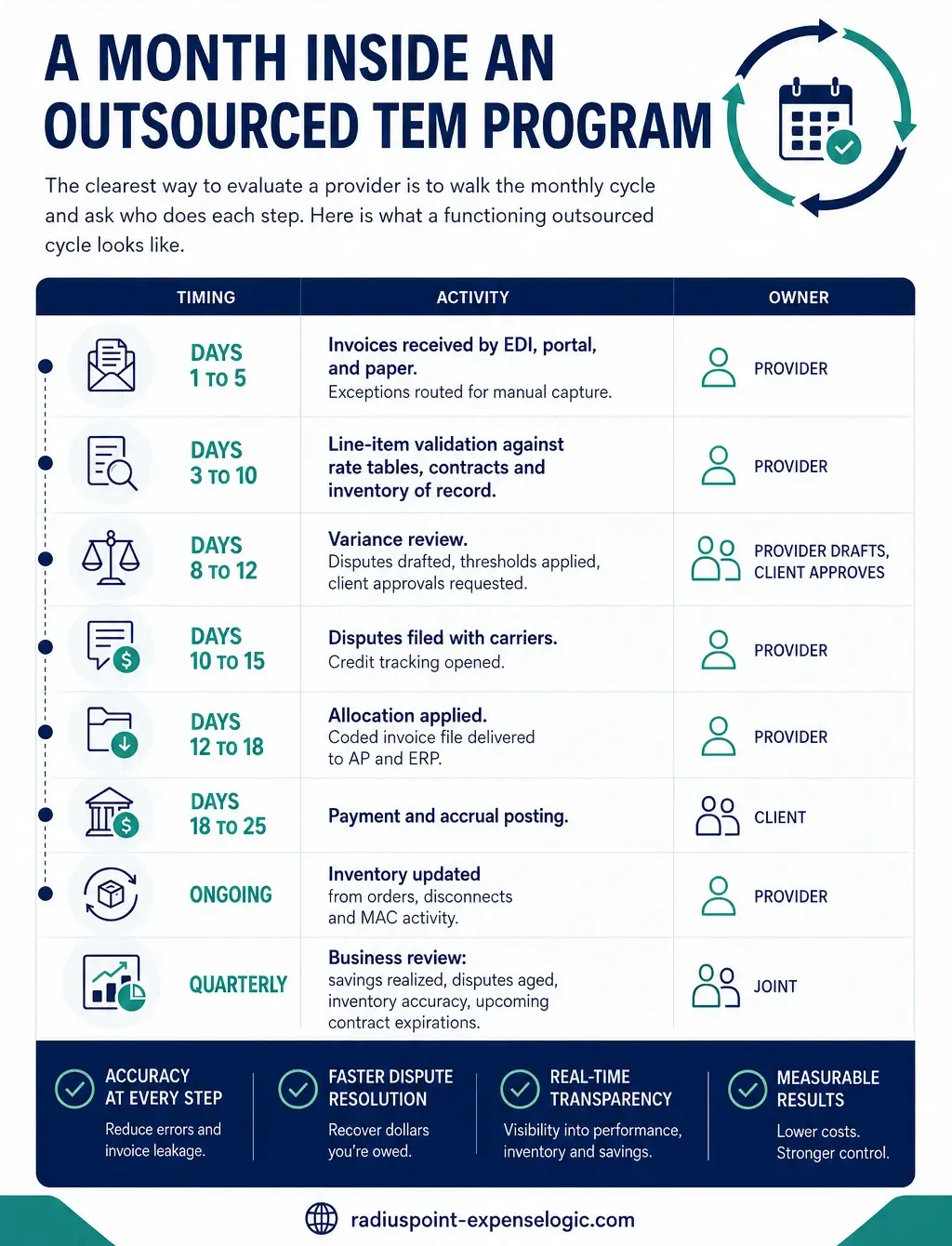
A Month Inside an Outsourced TEM Program
The clearest way to evaluate a provider is to walk the monthly cycle and ask who does each step. Here is what a functioning outsourced cycle looks like. Here we have made a handy infographic to walk you through the month:
 When Outsourcing Is the Wrong Answer
Outsourced telecom expense management is not universally correct, and providers who claim otherwise are worth discounting.
- Your estate is small and stable. Under a few hundred lines with little change activity, a disciplined spreadsheet and one focused hour a month can be adequate.
- You already have a staffed, mature function. If you have analysts who own the process and hit their dispute windows, buy them better software rather than replacing them.
- Your data is too disorganized to hand over, and you will not fund the cleanup. Providers can build the inventory, but not without client participation. A transition the client will not resource produces a program that reports on garbage.
- You are mid-migration. If you are three months from consolidating carriers or replacing your ERP, sequence the transition after the change rather than through it.
- Nobody internally will own it. This is the most common failure and the easiest to predict. Without an accountable owner, vendor output goes unread.
But it is best to consult before you make any decision. To book your call, simply click here.
Building the Business Case
A defensible business case compares three columns, not two.
Comparing outsourcing against a theoretical in-house program that does not exist today is how programs get approved and then underdeliver.
| Factor | Status quo (partial in-house) | Fully staffed in-house | Outsourced managed service |
|---|---|---|---|
| Labor | Distributed across IT, AP and finance, largely uncosted | Dedicated analysts plus software license and training | Provider fee, contractually fixed |
| Validation coverage | Sampling or exception review only | Depends on staffing discipline | Contractually defined, up to full line-item review |
| Dispute timeliness | Frequently outside carrier windows | Good when staffed, degrades with turnover | Governed by service level |
| Inventory accuracy | Degrades continuously | Maintained if resourced | Maintained as part of the service |
| Key person risk | High. One person holds the knowledge. | Moderate | Low. Process and data sit in the platform. |
| Scalability | Breaks at growth or acquisition | Requires new headcount | Absorbs volume change |
Quantify three things and the case largely writes itself: the fully loaded internal hours currently spent, the dollar value of disputes that expired unfiled in the last twelve months, and the variance between what the inventory says you have and what carriers are billing you for.
That third number is usually the one that ends the debate.
Outsourcing, Software, or a One-Time Audit
Outsourcing is one of three ways to address telecom spend, and organizations frequently buy the wrong one because the symptom looks the same from the outside. A rising invoice total can mean billing error, poor inventory hygiene, or simply growth. Each cause points to a different purchase.
| Option | What it solves | What it leaves open | Buy it when |
|---|---|---|---|
| One-time contingency audit | Historical billing errors, recovered as credits | Nothing about next month. The same errors resume. | You need a fast, self-funding proof that error exists |
| TEM software licence | Visibility, structure, a system of record | The labor. Someone still works the exceptions daily. | You have analysts and a process, and they are working in spreadsheets |
| Outsourced managed service | Visibility and the labor, under a service level | Governance. You still need an owner and a review cadence. | The work exceeds your staffing and you want a recurring outcome |
A useful sequencing pattern for organizations that need internal buy-in is to run a contingency audit first, use the recovered dollars as evidence of the size of the problem, and then move to a managed program before the same errors reaccumulate. The mistake is stopping after the audit, banking the refund, and treating a one-time recovery as a control.
Security, Compliance and Data Handling
Handing invoice and inventory data to a third party pulls in procurement and information security, and the review goes faster if you raise these items early rather than at contract stage.
- Employee data in mobility records. Wireless inventories contain names, device identifiers and sometimes location data. Confirm what the provider stores, for how long, and under which privacy basis.
- Independent assurance. Ask for a current SOC 2 Type II report or equivalent, and read the exceptions section rather than the cover page.
- Data residency and subprocessors. Establish where invoice data is processed and stored, and whether any part of validation is subcontracted offshore.
- Access model. Role-based access, single sign-on support, and a documented offboarding process for provider analysts who leave the account.
- Letters of authorization. Scope them to invoice access and dispute filing. A blanket letter of authorization that permits ordering or disconnecting services is broader than the service requires.
- Exit and portability. Named export formats for inventory, rate tables, contract records and dispute history, with a defined transition assistance period.
What Good Looks Like in Year One, Two and Three
Expectations set badly are the second most common reason outsourced programs get judged as failures. The value curve is not flat, and it does not peak where most business cases assume it does.
| Period | What is happening | What to measure |
|---|---|---|
| Months 1 to 6 | Inventory build, carrier account setup, rate table construction, first validated cycles | Percentage of invoices under management, inventory completeness, not savings |
| Months 6 to 12 | Historical error surfaces and disputes are filed in volume. Recovery peaks. | Disputed dollars filed, days to credit, first credits landing |
| Year 2 | Recovery falls because the estate is cleaner. Avoidance becomes the main value. | Cost avoided against baseline, inventory accuracy rate, contract renewals caught before expiry |
| Year 3 and beyond | Steady state. Value comes from optimization, disconnects and negotiation support. | Spend per line trend, unused service elimination, forecast accuracy |
Falling recovery in year two is a sign of success, not decline, and a business case that projects year-one recovery levels indefinitely will make a healthy program look like it is regressing. Write the avoidance baseline down in month one, while everyone still agrees what the starting position was.
Choosing a Provider to Outsource TEM
The outsourced segment includes generalist business process outsourcers, telecom-specific managed service providers, and software vendors offering a services wrapper.
Names that appear in this space include Valicom, E78 Partners, Socium, Bearstone, Lightyear and RadiusPoint, alongside the larger platform vendors covered in our guide to telecom expense management companies. Independent research from Gartner Peer Insights and benchmarks published by AOTMP are useful for understanding segment fit, and broader outsourcing research such as the Deloitte Global Outsourcing Survey is a reasonable frame for the governance side of the decision.
Weight your evaluation toward evidence rather than positioning.
Ask for a redacted dispute register. Ask for the inventory accuracy rate across their book of business. Ask to speak to a client who has been live for more than two years and has been through a carrier billing platform migration. Then read our overview of telecom expense management for the underlying discipline, and see how the economics played out for a manufacturer that moved from in-house review to a managed program.
Frequently Asked Questions
What does outsourced telecom expense management include?
It typically includes invoice collection and loading, line-item validation against contracts, dispute filing and tracking with carriers, inventory of record maintenance, cost allocation to cost centers and GL accounts, and reporting. Scope varies by provider, so confirm each item in the contract rather than the proposal.
Is outsourcing telecom expense management cheaper than doing it in-house?
It depends on the honest internal cost, which includes finance and accounts payable hours, not only telecom hours, plus the value of disputes that expire unfiled. Organizations running the process at partial capacity usually find outsourcing costs less than the leak it stops. Organizations with a fully staffed, disciplined function often do better buying software.
Do we lose control of our carrier relationships?
You should not. Well-structured programs keep contract negotiation, disconnect decisions, and executive carrier relationships with the client. The provider operates within those decisions and files disputes under a letter of authorization.
How long does it take to transition to an outsourced provider?
Three to six months is typical for an enterprise estate, and the majority of that time goes to building an accurate inventory rather than to software setup. Shorter timelines usually mean inventory reconciliation was deferred.
What internal resource do we still need?
One named owner who reviews provider output, approves disputes above an agreed threshold, and runs the quarterly business review. Expect a few hours a month, not a role.
Can an outsourced provider handle wireless and utility bills too?
Some can. Consolidating fixed telecom, mobility and utility invoices with one provider removes duplicate reconciliation across IT, finance and facilities. RadiusPoint manages all three through ExpenseLogic on a single platform.
What happens to our data if we change providers?
Your inventory, rate tables, contract records and dispute history should be contractually portable in a defined export format. Confirm this before signing, because reconstructing an inventory of record a second time is the single most expensive part of switching.
How quickly should we expect savings?
Recovery from historical billing errors often appears in the first two quarters, since it depends on auditing invoices already issued. Ongoing avoidance builds more slowly and depends on inventory accuracy reaching a stable state. Treat any projection that front-loads both as optimistic.